
Stay up to date with the latest stories and news from PCOM on Google.
Add us on GoogleHow to Deal with Stress as a Medical Student
August 16, 2021
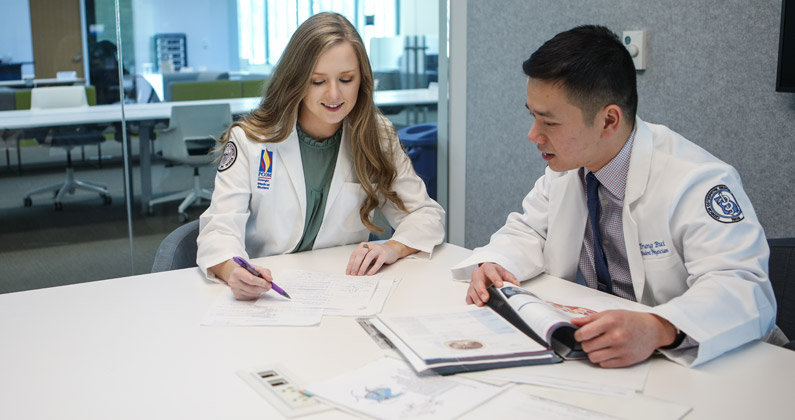 It is important for medical students to balance their academic schedule with mindfulness
and exercise. All photos were taken prior to the campus mask mandate.
It is important for medical students to balance their academic schedule with mindfulness
and exercise. All photos were taken prior to the campus mask mandate.
For many first-year medical students, leaving their hometown and loved ones for the first time—in addition to beginning a rigorous academic schedule with minimal social activities—can be stressful and, in some cases, negatively impact mental health. In the most recent PCOM Perspectives podcast, Jay Feldstein, DO ‘81, CEO and President of Philadelphia College of Osteopathic Medicine (PCOM) said it’s imperative that mental illness be discussed by students, faculty and staff.
“There’s nothing abnormal about being anxious or depressed,” he said. “People should be able to talk about their health in a safe environment and not feel judged.”
He added that talking about mental illness is really the best way to destigmatize it in society. He said, “Simone Biles has done more for mental health awareness in the last week than anyone has done in the last 15 years,” referring to Biles’ decision to not compete in the Olympics individual all-around competition in order to prioritize her mental health.
Ann Contrucci, MD, FAAP, a board-certified pediatrician and assistant professor of pediatrics at PCOM South Georgia has focused much of her career on mental illness and speaking out on the importance of mental health. Medical students, especially, face challenges when it comes to this topic.
“More than 20% of Americans are affected by a mental health illness,” said Dr. Contrucci. “Depression is diagnosed in 15-30% more of medical students than the general population. Additionally, suicide is higher amongst physicians. It’s 40% higher in male physicians than the general male population, and 30% higher in female physicians than the general female population.”
How to Deal With Stress During Medical School
With so many medical students dealing with mental health issues, Dr. Contrucci provides the following tips.
1. Have a proper sleep schedule
Medical students spend much of their time studying for tests, exams and boards. “The brain is an organ, too, and it has to be treated as one. It’s proven that retrieval of information can only be done with consistent sleep. Cramming only works briefly, not for long-term retrieval,” Dr. Contrucci said.
2. Eat nutritious foods
“Healthy does not imply the latest fad diet,” said Dr. Contrucci. “Healthy means eating all food groups in moderation. It also means being careful with things like alcohol or other mood-altering substances and staying hydrated.”
3. Exercise
Dr. Contrucci said that any exercise can be beneficial to students’ health. Further, multiple studies have found that yoga helps with anxiety. Exercise can be as simple as going for a walk daily or as consistently as possible. She added, “It can mean putting some tunes on and dancing. Exercise should be enjoyable and something that doesn't necessarily take hours to do. I know first-hand that medical students do not have the hours for that!”
4. Have social support
The COVID-19 pandemic gave many people the realization that we, as humans, need support. It highlighted the need for social support networks and having a “person” to confide in and socialize with. Dr. Contrucci clarified that “texting and social media are not support systems.”
5. Minimize social media and screen time
Multiple studies have shown the negative effect that social media and screen time have on students. Dr. Contrucci encourages medical students to maximize mindfulness and minimize mindlessness.
“Mindfulness can replace mindless scrolling on social media. This can be as simple as practicing breathing techniques a few minutes a day, short guided meditations once or twice a day or watching birds at a bird feeder. Baby steps help to turn something into a sustainable habit,” she said.
PCOM's Office of Student Affairs offers free counseling services at all locations for its students and encourages open discussions on mental health topics.
Listen to Dr. Feldstein and Dr. Contrucci discuss student mental health on the PCOM Perspectives podcast.
You May Also Like:
About PCOM South Georgia
In 2019, Philadelphia College of Osteopathic Medicine (PCOM), a premier osteopathic medical school established in 1899, extended its commitment to the Southeast by establishing PCOM South Georgia. An additional teaching location in Moultrie, Georgia, PCOM South Georgia offers both a full, four-year medical program leading to the Doctor of Osteopathic Medicine (DO) degree and a Master of Science in Biomedical Sciences. PCOM is a private, not-for-profit institution that trains professionals in the health and behavioral sciences fields. Joining PCOM Georgia in Suwanee in helping to meet the healthcare needs of the state, PCOM South Georgia focuses on educating physicians for the region. For more information, visit pcom.edu or call 229-668-3110.
Contact Us
For general media inquiries, please contact the Office of Marketing and Communications at 215-871-6300 or communications@pcom.edu. Visit our media relations page to view contact information for public relations personnel.