
Stay up to date with the latest stories and news from PCOM on Google.
Add us on GoogleJason Kaplan, DO ’13, Named Coordinator for AI Strategy
October 20, 2026
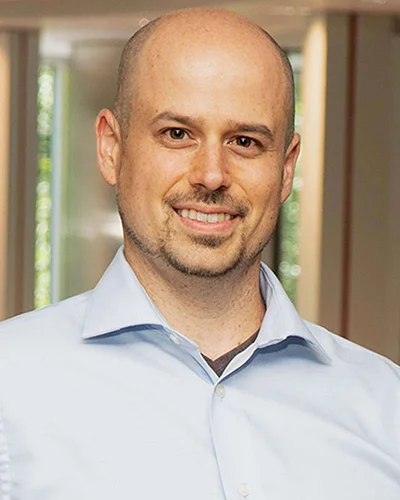
Artificial intelligence is increasingly shaping how health professionals learn, practice medicine, and care for patients. As PCOM’s new Coordinator for AI Strategy, Jason Kaplan, DO ’13, FACC, FASE, FASNC, FACP, will guide AI initiatives across the College's campuses and academic programs.
Kaplan, clinical professor and chair of the Division of Cardiology, also serves as clinical course director of cardiovascular medicine and online preceptor of clinical cardiology. Honored as one of the Pennsylvania Medical Society's 2025 Top Physicians Under 40 and PCOM's 2019 Innovative Teacher of the Year, Kaplan brings extensive experience in medical education to his new role.
“The College and medical education as a whole are entering a time where artificial intelligence is going to take a prominent seat at the table,” Kaplan said.
Bringing Together PCOM's AI Efforts
The position grew out of AI-related initiatives already underway across PCOM, including work involving library resources and medical education. As those efforts expanded, institutional leaders recognized an opportunity to establish a more coordinated approach.
Kaplan became involved after delivering a lecture on AI in cardiovascular medicine at a symposium organized by Erik Langenau, DO, MS, MAPP, director of PCOM's Center for Teaching Support and Professional Development (CTSPD). Based within CTSPD, Kaplan's new role will initially focus on cataloging existing AI technologies, educating students and faculty about available resources, and evaluating emerging tools.
He will also serve on PCOM's AI Governance Committee, which addresses security, privacy, ethics, and data governance, and chair a new AI Education Committee focused on curriculum development, faculty training, and student research. Kaplan also plans to establish research mentorship opportunities and explore an AI innovation group that could eventually develop new technologies within PCOM.
Preparing Students and Faculty for AI in Medicine
A central focus of Kaplan's educational strategy is what he calls “autonomous learning and cognitive preservation”—ensuring students develop essential clinical skills before relying on technology to supplement them. Students will learn to use AI tools while critically evaluating their accuracy, recognizing algorithmic bias, and understanding their limitations.
“We want students to use AI to enhance their understanding while preserving the core diagnostic reasoning and problem-solving skills essential to medical practice,” Kaplan said.
He compares the approach to mathematics: students must first learn fundamental skills before relying on a calculator. Similarly, AI can accelerate learning, but overreliance could compromise the development of essential clinical judgment.
Kaplan also hopes to expand faculty training, continuing medical education, and hands-on experiences with AI-enabled medical technologies. In cardiovascular medicine, for example, some echocardiography machines incorporate AI to assist with image acquisition and preliminary reports. Kaplan envisions a symposium-style experience where students could interact with similar technologies from multiple medical specialties.
Guiding the Future of AI at PCOM
Kaplan believes AI literacy will be increasingly important as students transition from medical education into clinical practice.
“We don't want them to graduate having ignored the AI piece,” he said. “It may be a part of everything that they're doing going forward.”
As PCOM expands its use of AI, four principles will guide its responsible implementation: privacy, accuracy, ownership, and human stewardship. Privacy involves protecting sensitive information, while accuracy requires critically evaluating AI-generated content. Ownership emphasizes transparency when using AI for activities such as brainstorming, drafting, or designing. Human stewardship ensures that people remain responsible for evaluating AI output and applying ethical judgment.
Looking ahead, Kaplan sees potential for AI to transform medical education through personalized learning. Generative AI can already help students create practice questions, identify knowledge gaps, and receive explanations of difficult concepts.
“It becomes both your test and your educator instantly,” Kaplan said.
He also envisions AI identifying patterns in student performance that could reveal learning difficulties earlier, allowing educators to provide additional support before problems become more significant. For Kaplan, success begins with helping students understand AI's clinical applications and approach emerging technologies with confidence.
You May Also Like:
About Philadelphia College of Osteopathic Medicine
Established in 1899, Philadelphia College of Osteopathic Medicine (PCOM) has trained thousands of highly competent, caring physicians, health practitioners and behavioral scientists who practice a “whole person” approach to care—treating people, not just symptoms. PCOM, a private, not-for-profit accredited institution of higher education, operates three campuses (PCOM, PCOM Georgia and PCOM South Georgia) and offers doctoral degrees in clinical psychology, educational psychology, osteopathic medicine, pharmacy, physical therapy, and school psychology. The college also offers graduate degrees in applied behavior analysis, applied positive psychology, biomedical sciences, forensic medicine, medical laboratory science, mental health counseling, physician assistant studies, and school psychology. PCOM students learn the importance of health promotion, research, education and service to the community. Through its community-based Healthcare Centers, PCOM provides care to medically underserved populations. For more information, visit pcom.edu or call 215-871-6100.
Contact Us
For general media inquiries, please contact the Office of Marketing and Communications at 215-871-6300 or communications@pcom.edu. Visit our media relations page to view contact information for public relations personnel.
Connect with PCOM
Media Inquiries
Kristen Hopf
Communications Content Specialist
Office of Marketing and Communications
Email: kristenho1@pcom.edu
Office: 215-871-6303