Stay up to date with the latest stories and news from PCOM on Google.
Add us on GoogleShepherding Future Physicians to Success
February 21, 2018
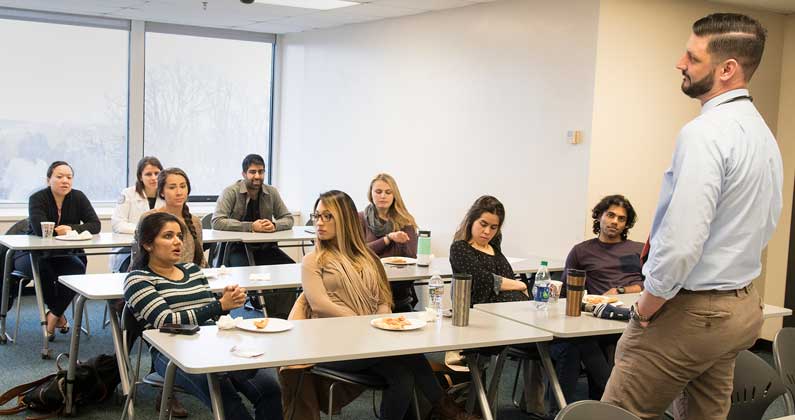 A new mentoring initiative in the DO program pairs students with faculty to assist
with personal and academic issues.
A new mentoring initiative in the DO program pairs students with faculty to assist
with personal and academic issues.
Even before medical students set foot in their first class, they face an enormous amount of pressure to perform at the highest levels: to get the best grades and land the best residency spot. That can take its toll mentally; a 2015 study published in BMC Medical Education found that the risk of depression rose significantly between a medical student’s first and third year, and also showed an increase in perceived stress levels.
One way PCOM is helping combat those issues among its doctor of osteopathic medicine (DO) students is to pair them with faculty members who can offer a unique perspective, as those who have been through the same situations the students have and are now successfully practicing in their specialties.
In 2015, Emily Eshleman (DO ’19) approached the DO Curriculum Committee with an idea: have students meet with those who had similar experiences and can offer trusted and effective career and personal advice—because they had lived it themselves.
“We took a survey among the students and the consensus was that they were interested in having a mentor,” said Ms. Eshleman, now a student liaison with the program. “This is an upstream solution to a lot of problems some students may otherwise face later and allows the faculty to identify students who may be at-risk and who can benefit from early intervention.”
Michael Becker, DO ’87, assistant dean of clerkship education and professor, family medicine; and Pat Lannutti, DO ’71, co-vice chair and professor, internal medicine, worked with students to implement
a formalized mentoring program. First- and second-year students were assigned a DO
faculty member who could serve as a counselor of sorts and help them deal with issues
from the academic, to the professional, to the personal. While not mandatory, students
are strongly encouraged to meet with their mentors as either part of a group—their
“Family”—or one-on-one at least once per semester.
+ View 2017-2018 DO Clinical Faculty Mentors
Donald Allison, DO ’09, assistant professor, OMM
Joshua Baron, DO ’03, clinical assistant professor, emergency medicine
Michael Becker, DO ’87, MS, assistant dean of clerkship education and professor, family medicine
Kristen Berry, DO ’00, instructor, family medicine
Peter Bidey, DO ’08, MEd, assistant professor, family medicine
Charmaine Chan, DO ’05, assistant professor, family medicine
Izola David, DO ’85, assistant professor, pediatrics
Larry Finkelstein, DO ’87, associate professor, family medicine
David Fuller, DO, professor, OMM
Katherine Galluzzi, DO, professor and chair, geriatrics
Joan Grzybowski, DO ’87, assistant professor, family medicine
Joseph Guagliardo, DO, professor, surgery
Michelle Hobson, DO ’80, clinical assistant professor, OMM
Joanne Kakaty-Monzo, DO ’97, clinical associate professor and academic chair, Ob/Gyn
David Kuo, DO ’96, associate dean, GME and associate professor, family medicine
Erik Langenau, DO, MS, chief academic technology officer and associate professor, family medicine
Pat Lannutti, DO ’71, co-vice chair and professor, internal medicine
Michael Levin, DO ’01, chair, Division of Nephrology and clinical associate professor, internal medicine
Harry Morris, DO ’78, MPH, professor and chair, family medicine
Marta Motel, DO ’88, assistant professor, family medicine
Laura Noto-Bell, DO ’06, associate professor, OMM
Daniel Parenti, DO ’87, professor and chair, internal medicine
Brian Penza, DO ’07, instructor, internal medicine
Erik Polan, DO ’07, assistant professor, internal medicine
Arthur Sesso, DO ’81, professor and chair, surgery
Madeline Sine-Karasick, DO, clinical assistant professor, radiology
Michael Srulevich, DO, MPH, associate professor, geriatrics
Michael Venditto, DO ’77, professor and chair, Division of Pulmonary and Critical Care Medicine
“We want to affirm that what students are feeling is normal, and to show that they’re not in it alone,” said Dr. Becker. “Through PCOM, we can offer a network of friends and colleagues who can help with those issues, and we want the students to feel that their school cares about them and is working to support them.”
“We’ve discovered a solution that complements the services PCOM currently offers for students who may be struggling,” added Dr. Lannutti. “No student should feel like they’re falling through the cracks.”
The program formally launched in 2016, and students have responded positively to the experience. In a recent survey given to first- and second-year DO students, more than 60 percent of respondents said that overall, they were either “satisfied” or “very satisfied” with the program.
Brisha Bhikadiya, (DO ’20), said that she was able to shadow her mentor, Erik Polan, DO ’07, assistant professor, internal medicine, during his rounds at Roxborough Hospital several times.
“It was a great way to get clinical experience and learn about how medicine works in the real world,” she said. “I was there when he gave a patient a poor prognosis, and it was interesting to encounter that so early in my medical career. We practice on standardized patients, but it’s different to see it with a real patient.”
Each faculty mentor is provided with a handbook which includes information related to financial aid, lists of local alumni, frequently asked questions about the Comprehensive Osteopathic Medical Licensing Examination of the United States, the United States Medical Licensing Examination and more, to help mentors as they guide their “family members.”
“We do our best to put their stress into perspective,” said Dr. Polan. “We try to help guide them and uncover any struggles the students may be having, and if we see any, direct them to the resources that PCOM offers for both emotional and academic support.”
Not only do DO students gain academic and emotional support; Student Liaison Danielle Estrada (DO '20) says they also gain a better understanding of what it means to be a compassionate, caring physician.
“We learn how to be human beings through our interactions with faculty,” she said.
You May Also Like:
- Program Aims to Break Mental Health Stigmas
- DO Students Mentor High School Students
- DO Student Founds Nonprofit to Guide Girls Toward Medical School
About Philadelphia College of Osteopathic Medicine
Established in 1899, Philadelphia College of Osteopathic Medicine (PCOM) has trained thousands of highly competent, caring physicians, health practitioners and behavioral scientists who practice a “whole person” approach to care—treating people, not just symptoms. PCOM, a private, not-for-profit accredited institution of higher education, operates three campuses (PCOM, PCOM Georgia and PCOM South Georgia) and offers doctoral degrees in clinical psychology, educational psychology, osteopathic medicine, pharmacy, physical therapy, and school psychology. The college also offers graduate degrees in applied behavior analysis, applied positive psychology, biomedical sciences, forensic medicine, medical laboratory science, mental health counseling, physician assistant studies, and school psychology. PCOM students learn the importance of health promotion, research, education and service to the community. Through its community-based Healthcare Centers, PCOM provides care to medically underserved populations. For more information, visit pcom.edu or call 215-871-6100.
Contact Us
For general media inquiries, please contact the Office of Marketing and Communications at 215-871-6300 or communications@pcom.edu. Visit our media relations page to view contact information for public relations personnel.