
Stay up to date with the latest stories and news from PCOM on Google.
Add us on GooglePCOM Student Wins National OMM Case Competition
May 22, 2026
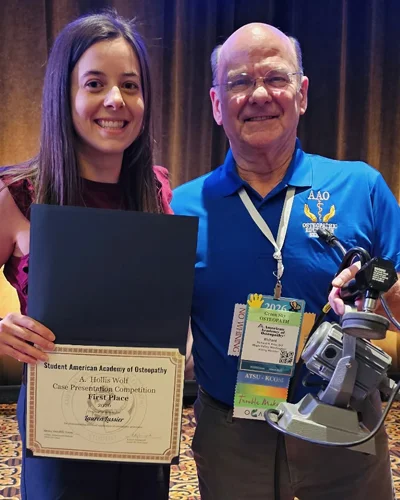
When Lauren Lussier (DO ’27) stepped onto the stage at the American Academy of Osteopathy (AAO) Convocation in Colorado Springs this spring, she carried years of osteopathic training and a clinical case that highlighted the broader possibilities of osteopathic manipulative medicine (OMM).
By the end of the competition, the third-year Doctor of Osteopathic Medicine student and OMM Scholar at PCOM had earned first place in the A. Hollis Wolf Case Presentation Competition, a national event where osteopathic medical students present clinical cases involving osteopathic manipulative treatment (OMT).
Competing against 30 students from osteopathic medical schools across the country, Lussier presented a rare case involving a 73-year-old woman whose chronic abdominal pain had gone undiagnosed for years. Through osteopathic evaluation and OMT sessions, the patient experienced significant relief and regained her quality of life.
“This patient had seen so many specialists and still didn’t have answers,” Lussier said. “Then through OMT, we were able to help identify what was happening and improve her symptoms.”
Teaching, Service and Osteopathic Medicine
Originally from Pittsburgh, Lussier studied chemistry and Spanish at the University of Pittsburgh, where she developed an interest in teaching through work as a teaching assistant and student researcher. That passion for education—and the supportive environment she found at PCOM—helped shape both her decision to attend the College and her path into the OMM Scholar program.
As an OMM Scholar, Lussier spends an additional year teaching OMM to junior students while training alongside attending physicians in clinical settings. After medical school, she hopes to pursue emergency medicine and incorporate OMM into her future practice.
“OMM can be important in terms of acute pain relief and helping patients feel more comfortable,” she said. “Even in emergency medicine, there are things you can do in a short amount of time that make a meaningful difference for a patient.”
A Rare Case With Lasting Impact
The patient case that became the subject of Lussier’s presentation began during an OMM clinic rotation, where she worked alongside attending physicians evaluating a patient with severe scoliosis, chronic abdominal pain, and worsening digestive symptoms.
After years of unsuccessful treatment attempts and inconclusive diagnoses, an osteopathic structural examination revealed significant fascial and muscular strain patterns in the abdominal region. Additional imaging ultimately identified median arcuate ligament syndrome, a rare condition involving compression of a major abdominal artery.
Because the patient was not considered a surgical candidate due to previous poor responses to anesthesia, the clinical team pursued conservative management through OMT. Over the course of five treatment sessions focused on diaphragmatic release, abdominal musculature and compensatory structural patterns related to scoliosis, the patient experienced substantial improvement.
“She told us she felt like she had her quality of life back,” Lussier said. “She could go out to eat with friends again. That’s meaningful as a clinician: helping someone get back to living their life. A lot of people think OMT is only used for things like low back pain or musculoskeletal injuries, but it can be used in so many different ways. It’s much more multifaceted than people realize.”
Learning Through Teaching
Lussier began preparing her presentation in December, refining the case through months of revisions and weekly practice sessions with PCOM faculty and fellow scholars. Among the mentors who helped guide her preparation were Michelle Hobson, DO; Meghna Patel, DO; and Alberto Giardini, DO '19.
For Lussier, the experience at AAO deepened her appreciation for the connection between clinical care, teaching and lifelong learning. She credits the OMM Scholar program with strengthening her technical skills and showing her how osteopathic principles translate into patient care—and ultimately shaping the kind of physician she hopes to become.
“The first two years teach you the techniques, but the OMM Scholar program helps you learn how to apply them in real clinical settings and develop your own style as a physician,” she said. “Teaching builds on what I know while reminding me to stay open-minded and keep learning. This experience reinforced that I want teaching to be part of my life in medicine.”
You May Also Like:
About Philadelphia College of Osteopathic Medicine
Established in 1899, Philadelphia College of Osteopathic Medicine (PCOM) has trained thousands of highly competent, caring physicians, health practitioners and behavioral scientists who practice a “whole person” approach to care—treating people, not just symptoms. PCOM, a private, not-for-profit accredited institution of higher education, operates three campuses (PCOM, PCOM Georgia and PCOM South Georgia) and offers doctoral degrees in clinical psychology, educational psychology, osteopathic medicine, pharmacy, physical therapy, and school psychology. The college also offers graduate degrees in applied behavior analysis, applied positive psychology, biomedical sciences, forensic medicine, medical laboratory science, mental health counseling, physician assistant studies, and school psychology. PCOM students learn the importance of health promotion, research, education and service to the community. Through its community-based Healthcare Centers, PCOM provides care to medically underserved populations. For more information, visit pcom.edu or call 215-871-6100.
Contact Us
For general media inquiries, please contact the Office of Marketing and Communications at 215-871-6300 or communications@pcom.edu. Visit our media relations page to view contact information for public relations personnel.
Connect with PCOM
Media Inquiries
Kristen Hopf
Communications Content Specialist
Office of Marketing and Communications
Email: kristenho1@pcom.edu
Office: 215-871-6303