
Stay up to date with the latest stories and news from PCOM on Google.
Add us on GoogleBuilding Confidence in Anatomy Lab:
Advice for Medical Students
October 21, 2026
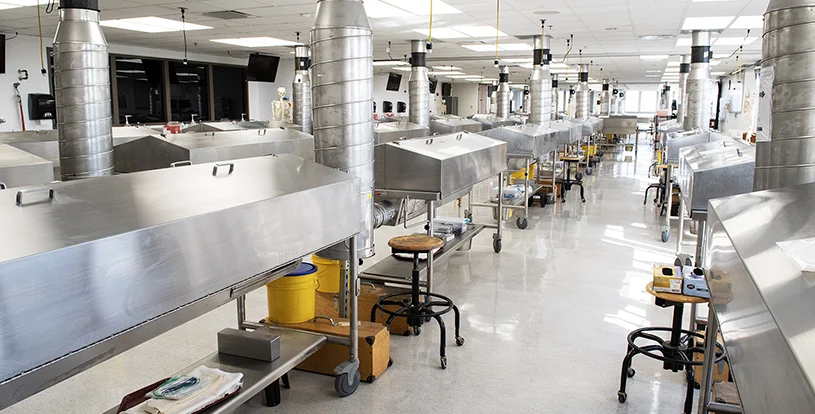
For many medical students, anatomy lab marks one of their first opportunities to learn directly from the human body—and from the individuals who chose to donate theirs to medical education. The experience can bring a mix of curiosity, excitement and apprehension, something Julie Huss, DC, MBA, assistant director of the PCOM Human Anatomy Laboratory, understands firsthand.
“When I was getting started in graduate school, I had never seen a human body before. I had never held a scalpel. It was all new to me,” Huss said.
To help students navigate the experience, PCOM's anatomy team introduces them to the lab environment gradually. Donors are initially kept in clean, white body bags beneath the lids of stainless-steel tables, and faculty guide students through the process of opening the tables, beginning with a moment of silence. Students typically work in groups of four to six per donor, with instructors and teaching assistants providing guidance throughout the course.
Learning From Your First Patient
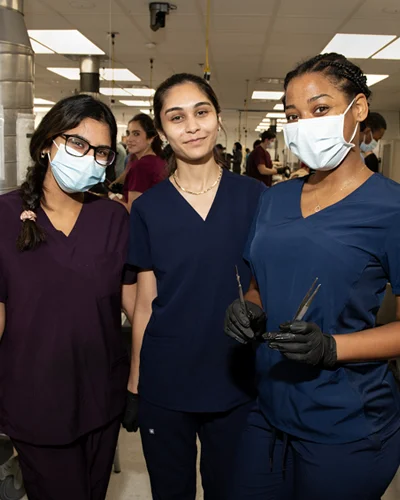
Huss says the anatomy lab teaches students more than how to identify muscles, nerves and blood vessels. It also introduces important lessons about respect, responsibility and the realities of caring for the human body. Students are encouraged to think of their donor as their first patient, remembering that each individual made a conscious decision to contribute to medical education.
“We make the experience very respectful and medical,” Huss said. “You’re actually honoring their gift by learning from them as completely and appropriately as you can.”
Jeff Seiple, MBA, LFD, LE, chief of PCOM Anatomical Services, describes accepting the donor’s gift as carrying “a strict moral and professional obligation.” Donor identities are kept confidential and their use closely supervised, while students begin developing values they will carry into patient care.
Students also encounter aspects of human anatomy that differ from textbooks. Following embalming, tissues appear differently than living tissue. Students can feel the weight of an organ, trace nerves and observe anatomical variations.
For Huss, these hands-on experiences illustrate why digital anatomy programs, imaging and 3D models serve as supplements rather than replacements for donor-based anatomy education. In anatomy lab, students may encounter tumors, evidence of disease and other conditions while studying the structures around them.
“You can look at as many pictures as you want, but there’s no substitute for experiencing what the human body feels and looks like until you’re physically there,” Huss said.
Building Confidence in Anatomy Lab
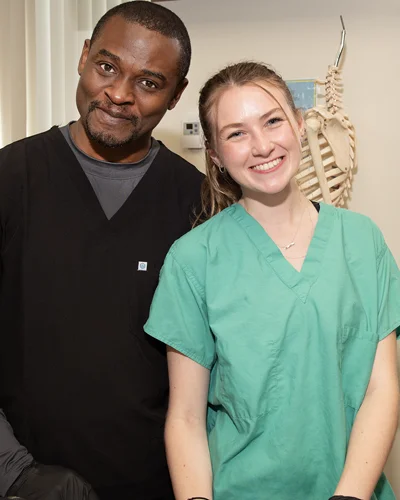
Emma Sevick (DO ’28), a third-year student in the Doctor of Osteopathic Medicine program and anatomy teaching assistant, remembers feeling nervous when she first entered the anatomy lab as a student in PCOM’s Biomedical Sciences master's program. Now helping other students navigate the same experience, she understands that uncertainty is a natural part of learning anatomy.
“Gross anatomy can be intimidating, and it is completely normal to experience a range of emotions when you first enter the lab,” Sevick said. “You are not alone in feeling confused or overwhelmed.”
Students aren't expected to arrive with dissection experience. Sevick has watched hundreds of students develop confidence with support from faculty and teaching assistants, eventually identifying anatomical structures and teaching their peers.
“Ultimately, I think students become comfortable and confident in anatomy when they realize they do not have to master everything or do it alone,” Sevick said. “Having supportive classmates, utilizing faculty, and approaching the material with a positive and sometimes playful attitude can completely change the experience.”
Sevick encourages students to ask questions, attend review sessions and find creative ways to study, including “silly songs, dances, mnemonics, and stories” to help remember complex anatomical concepts.
For PCOM's DO students, anatomy spans nearly two academic terms, with one to three lab sessions per week, each lasting approximately three hours. Huss urges students to actively participate, even if they initially feel uncomfortable holding a scalpel. She also offers one practical piece of advice: Eat breakfast. Students who feel faint in the lab sometimes simply haven't eaten for many hours.
Over time, anatomy lab can help students discover their strengths and interests. Some develop an unexpected passion for anatomy and begin considering surgical specialties, while others realize their interests lie elsewhere. Beyond developing anatomical knowledge, students leave the lab with greater confidence, a deeper understanding of patient care and, sometimes, new perspectives on their future medical careers.
For Sevick, who remembers her own uncertainty entering the lab, the message to incoming students is simple: “It’s OK to be nervous. You are capable of doing hard things, and you deserve to be in this room.”
You May Also Like:
About Philadelphia College of Osteopathic Medicine
Established in 1899, Philadelphia College of Osteopathic Medicine (PCOM) has trained thousands of highly competent, caring physicians, health practitioners and behavioral scientists who practice a “whole person” approach to care—treating people, not just symptoms. PCOM, a private, not-for-profit accredited institution of higher education, operates three campuses (PCOM, PCOM Georgia and PCOM South Georgia) and offers doctoral degrees in clinical psychology, educational psychology, osteopathic medicine, pharmacy, physical therapy, and school psychology. The college also offers graduate degrees in applied behavior analysis, applied positive psychology, biomedical sciences, forensic medicine, medical laboratory science, mental health counseling, physician assistant studies, and school psychology. PCOM students learn the importance of health promotion, research, education and service to the community. Through its community-based Healthcare Centers, PCOM provides care to medically underserved populations. For more information, visit pcom.edu or call 215-871-6100.
Contact Us
For general media inquiries, please contact the Office of Marketing and Communications at 215-871-6300 or communications@pcom.edu. Visit our media relations page to view contact information for public relations personnel.
Connect with PCOM
Media Inquiries
Kristen Hopf
Communications Content Specialist
Office of Marketing and Communications
Email: kristenho1@pcom.edu
Office: 215-871-6303