
Stay up to date with the latest stories and news from PCOM on Google.
Add us on GoogleProgress Isn't Linear:
A Doctor of Physical Therapy Student Embraces a Whole-Person Approach
January 28, 2026
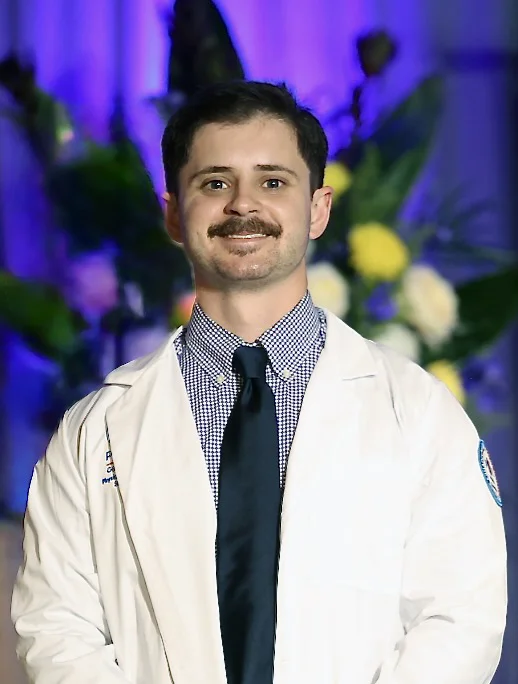
Growing up on baseball fields around Hoschton, Georgia, Reese Stokes (DPT '27) experienced repeated overuse injuries that led him to physical therapy. Those experiences sparked an early fascination with how exercise could relieve pain, restore movement and support overall well-being—an interest that guided his undergraduate studies in athletic training and exercise science at the University of North Georgia and later led him to pursue a Doctor of Physical Therapy degree at PCOM Georgia.
Keeping an Open Mind in Rotations
Before beginning his clinical rotations, Stokes envisioned a future in sports medicine, helping athletes recover from injuries—a passion rooted in his days on the baseball field. During his first rotation in neurologic physical therapy at an outpatient hospital, however, there was one patient interaction that left a lasting impression and prompted him to consider his future specialty with an open mind.
Walking into his first clinical rotation, he admits he was a little nervous. His neuroscience coursework had been demanding, and he wasn't sure what to expect in a real-world setting. The experience quickly became transformative, however, largely due to the guidance of his clinical instructor, Marla Perez, PT, DPT, NCS, a board-certified neurological clinical specialist.
“Dr. Perez taught me not just how to be a neurological PT, but how to adapt,” Stokes said. “She helped me build confidence and understand the importance of listening to each patient.”
Learning to Adapt Beyond the Diagnosis
These lessons became particularly clear during an encounter with a patient who arrived unusually subdued one day. The plan for the session was simple—just a short 20–30 foot walk—but the patient's emotional state was the real barrier.
“The patient was expressing that she was overwhelmed by her life situation at the time, and that she felt discouraged by her progress,” Stokes said. “I could tell that she needed to get something off her chest.”
He sat with her, listened and offered encouragement—reminding her that progress isn't always linear, that there are ups and downs, and that the steps she was taking, even small ones, mattered. He also helped her reflect on how far she had already come, progress she wasn't able to see in the moment. Only then did they attempt the walk—ultimately going farther than either of them expected when the session began.
“Having that patient confide in me showed me that physical therapy is about more than physical treatment,” Stokes said. “Understanding the emotional side of what patients are experiencing is just as important.”
The Impact of Whole-Person Care
It wasn't just Stokes' clinical skills that stood out to Perez; it was his empathy, patience and ability to meet the patient where she was.
“Reese not only provided compassionate listening but was also able to educate and motivate her to get working hard to achieve what she is very capable of,” said Perez. “I've been taking students for the majority of my nearly 10-year career, and that level of empathy and compassion in a first-rotation student is just unheard of.”
By the final weeks of the rotation, Stokes was independently managing most of the caseload—something he credits to jumping in, asking questions and allowing himself to learn through doing. It's the same advice he now offers to students preparing for their first rotation.
“Your rotation will reflect what you put into it,” he said.
You May Also Like:
About PCOM Georgia
PCOM Georgia has been serving students and the community for 20 years as a branch campus of Philadelphia College of Osteopathic Medicine (PCOM), a private, not-for-profit, accredited institution of higher education established in 1899. Located in Suwanee (Gwinnett County), PCOM Georgia offers doctoral degrees in osteopathic medicine, pharmacy and physical therapy. Graduate degrees are offered in biomedical sciences, medical laboratory science and physician assistant studies. The campus joins PCOM South Georgia in Moultrie in helping to meet the healthcare needs of the state. Emphasizing "a whole person" approach to care, PCOM Georgia focuses on educational excellence, interprofessional education and service to the community. For more information, visit pcom.edu or call 678-225-7500. The campus is also home to the Georgia Osteopathic Care Center, an osteopathic manipulative medicine clinic, which is open to the public by appointment. For more information, visit pcomgeorgiahealth.org.
Contact Us
For general media inquiries, please contact the Office of Marketing and Communications at 215-871-6300 or communications@pcom.edu. Visit our media relations page to view contact information for public relations personnel.
Connect with PCOM Georgia
Media Inquiries
Kristen Hopf
Communications Content Specialist
Office of Marketing and Communications
Email: kristenho1@pcom.edu
Office: 215-871-6303