
Medical Laboratory Science
Master of Science Programs
- Prepare for an exciting career as a vital healthcare team member
- Receive comprehensive training across major disciplines
- Learn to provide accurate, reliable test results

Request Information
Loading...
Medical Laboratory Science
Master of Science Programs
The Master of Science (MS) in Medical Laboratory Science programs are designed to prepare graduates to enter the medical laboratory field in integral roles providing diagnostic services to physicians and practitioners. PCOM offers pre-professional and post-professional degree options.
What is a Medical Laboratory Scientist?
Medical laboratory scientists, often referred to as medical technologists, perform a wide array of tests on blood and body fluids, reporting all results to the ordering physicians. Their role in medical diagnostics is critical to physicians to aid in medical diagnoses. The complex testing performed on the blood and body fluids aids in the diagnosis and treatment of cancers, anemias, an array of infectious processes, and diseases.
The field of laboratory science is comprised of five major disciplines: clinical hematology and coagulation, clinical chemistry, immunohematology, medical microbiology, urinalysis and body fluids. The five major disciplines have an array of sub-specialties which are taught and trained within the program as well.
This is a carousel. Use the Next and Previous buttons to navigate through the slides.
What Our Students Say
“One of the best things about being a medical laboratory scientist is to be able to work behind the scenes, but still play an important role on the healthcare team.”
Ures Sarmiento, MS/MLS '23

“I love the medical laboratory profession, and I can't see myself in any other field. I desire to bring awareness to the medical laboratory science profession. We are a hidden profession, yet we are very much needed in the healthcare industry.”
Violeshia Greene, MS/MLS '24

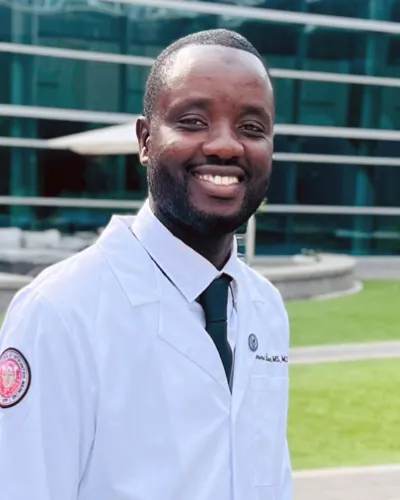
“I realized that even without direct patient interaction, I could make a big impact on healthcare, specifically patient care by providing accurate lab results that guide clinicians' decisions.”
Ebrima Danso, MS/MLS '25
Medical Laboratory Science Master's Degree Options
The Master of Science in Medical Laboratory Science is designed to prepare graduates for an exciting career in medical laboratory science, enabling them to provide accurate, reliable test results that aid in diagnosis. PCOM offers two degree options:
Pre-Professional
This unique, hybrid program features coursework delivered in an online format, with monthly, intensive laboratory experience during an all-day weekend setting. Students entering the pre-professional program will have a conferred BS degree in a biologic or chemical science with appropriate prerequisite courses. This route requires all graduates to complete campus-based labs monthly and participate in five clinical rotations (one in each major discipline) for a total of 160 onsite hours of internship in each area. Students will be eligible to sit for the American Society for Clinical Pathology (ASCP) certification exam upon successful completion of the program.
Post-Professional
The online MS in Medical Laboratory Science degree program is designed for students who hold a bachelor's degree in medical or clinical laboratory science from a National Accreditation Agency for Clinical Laboratory Sciences (NAACLS) accredited program and are certified by either ASCP or AMT. No clinical internship is required.
More Information
Medical Laboratory Science Course of Study
Laboratory scientists study many specialized science courses specific to their work needs. These include:
- clinical chemistry
- hematology
- microbiology
- immunohematology
- immunology/serology
- parasitology/mycology/virology
- urinalysis and body fluids
Each of these disciplines prepares a clinical lab scientist for all sample sources they may encounter in their workplace. Each student will take the above listed courses in their program, which will enable them to sit for the national certification examination.
Work Environment
Medical laboratory scientists are employed in a myriad of settings including:
- hospital laboratories
- reference laboratories
- public health laboratories such as the CDC
- forensic laboratories
- blood donation centers
- pharmaceutical and biomedical laboratories
- research laboratories
- veterinary labs
Laboratories are temperature-controlled environments, equipped with ventilation systems and workplace safety mechanisms in place to provide a safe working environment. Depending on the department a scientist is assigned to work, sitting, standing, lifting and bending will be required throughout a work shift.
Career Outlook for Medical Laboratory Scientists
As the population ages and chronic disease rates rise, demand for healthcare services—and the medical scientists who support them—is expected to increase. According to the U.S. Bureau of Labor and Statistics, approximately 10,500 openings are projected on average each year over the next decade.
MLS Student Handbook
The Student Handbook for Medical Laboratory Science (MLS) compiles administrative policies governing actions related to PCOM's MLS graduate students and includes information about the college and current practices that may be of use to MLS students. Some material may summarize college policies, and where possible, references to the complete PCOM policy are provided. Policy statements are subject to change and will be updated regularly. Changes and new material will be promptly published and distributed to MLS students. This document is not a contract.
DOWNLOAD MLS STUDENT HANDBOOK
Resources
For more information about medical laboratory scientists, certification and workforce outlook, please visit the following resources:
Accreditation
The PCOM graduate program for Medical Laboratory Science is accredited by the National Accrediting Agency for Clinical Laboratory Sciences (NAACLS), located at 5600 N. River Rd. Suite 720, Rosemont, IL 60018-5119; 773-714-8880. The program was granted initial accreditation for five years on April 30, 2025. Additional information regarding NAACLS can be found on the web at www.naacls.org.
Program
Philadelphia College of Osteopathic Medicine
625 Old Peachtree Rd
Suwanee, GA 30024
Program Director
Cost of Attendance and Financial Aid
PCOM is committed to helping students maximize funding sources and minimize student debt. Visit our Office of Financial Aid section to learn about cost of attendance, types of aid available and how to apply for financial aid.
Tuition Calculator