
Forensic Medicine
at PCOM
- Gain hands-on experience interpreting evidence
- Develop analytical and critical thinking skills
- Learn from experts in the field
- Prepare for a variety of in-demand careers
Forensic Medicine at PCOM
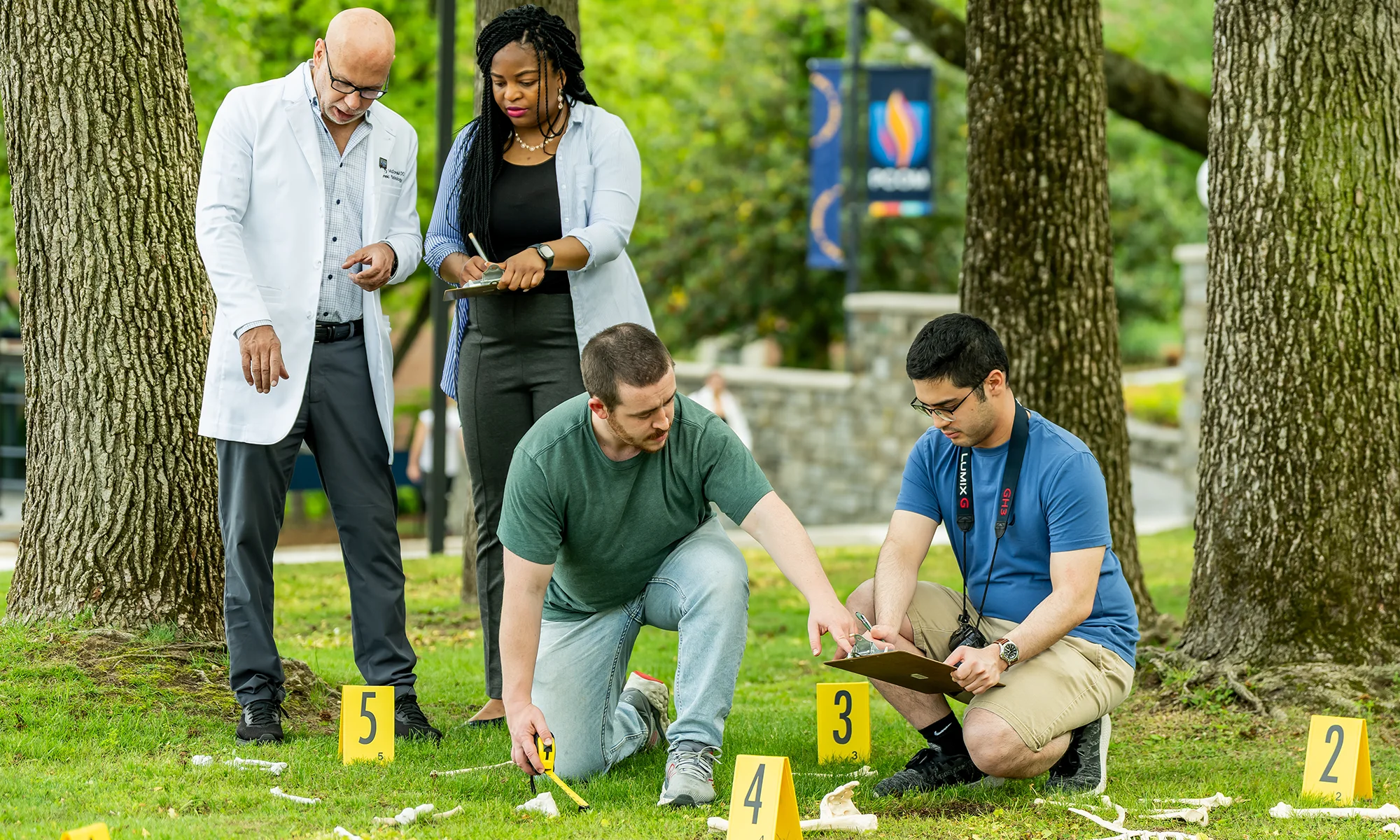
Students at PCOM learn forensic medicine by doing forensic medicine. Under the guidance of professional investigators, students gather in teams to conduct their own investigations—from mock crime scenes to accident reconstructions to clandestine gravesites. Our program is designed to help students develop the analytical and critical thinking skills needed for a variety of in-demand careers.
What is Forensic Medicine?
Forensic medicine is the evaluation of victims to determine the cause of injury or death. For living victims, it is used to determine how an injury occurred—including the weapon used or force applied—and if the facts established through scientific investigation are consistent with the story provided by the victim or other party. In evaluating deceased victims, forensic experts investigate the circumstances surrounding death in order to interpret trauma, establish time of death and determine if the death resulted from an intentional act or natural disease.
Hands-on Learning, Expert Instruction in Forensic Pathology
PCOM offers one of the only forensic medicine programs in the region that was developed and is overseen by a board-certified forensic pathologist. With courses taught by leading experts currently working in the field, students learn from professionals who bring in-depth knowledge and years of field experience.
APPLY ONLINEGregory McDonald, DO ’89, chair of PCOM's Department of Forensic Medicine and Pathology, is a member of the Vidocq Society, an organization of forensic experts who help law enforcement agencies solve cold cases. [Read more].
EXPLORE FORENSICS AT PCOM
Online Pathway Course (for Non-Science Majors)
The Online Pathway is a summer preparatory course designed to prepare students for entry into our master's program. The program is offered 100 percent online.
Learn About the Pathway Course
Master of Science (MS) in Forensic Medicine Program
The MS program is designed for individuals who have an undergraduate degree and background in the sciences. The highly experiential program focuses on the evaluation of live and deceased victims. The program provides students with a baseline of analytic and critical thinking skills that will prepare them to become medical and legal death investigators.
LEARN MOREPCOM's MS program includes a heavy concentration in pathology and diseases and how those impact the overall determination of cause of death. Forensic professionals go to crime scenes, assist with autopsies and gather specimens which are then provided to forensic scientists for analysis.
What forensic courses will I take?
PCOM students engage in a broad—and very active—study of the forensic field covering topics including:
- forensic pathology;
- forensic anthropology (identification and investigation of human remains);
- forensic odontology (dental evidence);
- forensic entomology (insect evidence);
- ballistics, fingerprint, crime scene and blood spatter analysis;
- toxicology;
- DNA;
- arson and fire investigation;
- evaluation of sexual assault victims;
- and more.
What kind of backgrounds do forensic students have?
The program welcomes and trains both newcomers and professionals currently in the forensics field, preparing them for a variety of rewarding careers in the field. Typically, our enrolled students have backgrounds as:
- Physicians
- Physician Assistants
- Nurses (BSN and beyond, e.g. Nurse Practitioner)
- Paramedics
- Criminal Investigators
- Coroners
- Law Enforcement Professionals
DO/MS Dual Degree
Doctor of Osteopathic medicine students may pursue a dual DO/MS in Forensic Medicine degree during an extended second year in which students complete forensic classes.
LEARN MOREDO/MS Degree Career Options
Post-medical school (DO program) careers include:
- pediatrician (concentration in child abuse)
- geriatrician (concentration in elder abuse)
- emergency medicine
- medical examiner
Learn more about forensic careers.
Forensic Biology Concentration
Students in the MS in Biomedical Sciences program may pursue a concentration in forensic biology after completing foundation year coursework.
LEARN MORE