
Stay up to date with the latest stories and news from PCOM on Google.
Add us on GoogleMedical Student Research Advances Eating Disorder Awareness
February 17, 2026
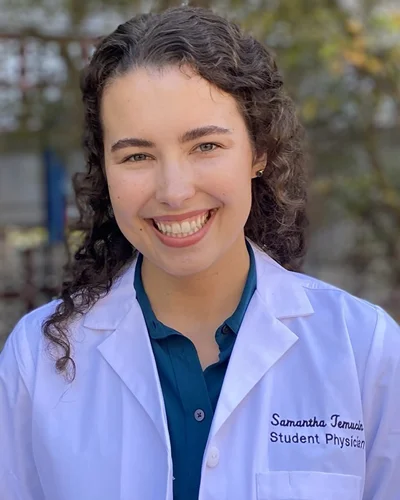
For Samantha Temucin (DO ’26), a fourth-year medical student at Philadelphia College of Osteopathic Medicine (PCOM), preparing for a career in medicine includes recognizing conditions that are frequently overlooked, including eating disorders.
In New Bern, North Carolina, Temucin’s years as a competitive gymnast meant countless injuries and trips to the doctor—experiences that gradually inspired her interest in healthcare.
“I was in and out of doctors’ offices a lot because of gymnastics, and I actually found myself looking forward to going,” Temucin said. “I was fascinated watching doctors figure out what was wrong and how they came up with different ways to fix it.”
After earning an undergraduate degree at North Carolina State University, Temucin wanted a change of scenery and an experience of living in a big city. That goal led to PCOM, where she began preparations for a future residency in general surgery.
“I can’t see myself doing anything else,” Temucin said. “I love it.”
While Temucin’s future is focused on surgery, eating disorder research has always been an area of interest for her, driven by a desire to ensure physicians have the knowledge to identify eating disorders and connect patients with appropriate care.
Temucin is a co-author of a study titled Assessing eating disorder education in U.S. medical schools: a qualitative content analysis of lecture slides that examines how eating disorders are taught in U.S. medical schools. With limited research on the topic, this study helps shed light on how preclinical medical education addresses eating disorders and where gaps remain. The research analyzed lecture slides used in preclinical education and identified shortcomings in how future physicians are trained to recognize and respond to these conditions.

The study found that most lectures emphasize anorexia nervosa and bulimia nervosa, with limited attention given to other disorders such as binge eating disorder and avoidant-restrictive food intake disorder (ARFID). Visual materials often reinforced narrow assumptions about who develops eating disorders. Weight stigma—a known barrier to diagnosis and treatment—was rarely addressed.
For Temucin, these findings highlighted a critical need for stronger education at the medical school level.
“If doctors don’t know what to look for or don’t feel confident addressing it, patients can slip through the cracks,” Temucin said.
Temucin became involved in the project through Medical Students for Size Inclusivity, a national organization focused on reducing weight stigma in health care. Through that work, an opportunity emerged to help improve how future physicians are trained to identify and respond to eating disorders.
“Our goal isn’t to make every medical student an eating disorder expert,” Temucin said. “It’s about giving medical students a foundation so a problem can be recognized and patients can be guided toward care.”
You May Also Like:
About Philadelphia College of Osteopathic Medicine
Established in 1899, Philadelphia College of Osteopathic Medicine (PCOM) has trained thousands of highly competent, caring physicians, health practitioners and behavioral scientists who practice a “whole person” approach to care—treating people, not just symptoms. PCOM, a private, not-for-profit accredited institution of higher education, operates three campuses (PCOM, PCOM Georgia and PCOM South Georgia) and offers doctoral degrees in clinical psychology, educational psychology, osteopathic medicine, pharmacy, physical therapy, and school psychology. The college also offers graduate degrees in applied behavior analysis, applied positive psychology, biomedical sciences, forensic medicine, medical laboratory science, mental health counseling, physician assistant studies, and school psychology. PCOM students learn the importance of health promotion, research, education and service to the community. Through its community-based Healthcare Centers, PCOM provides care to medically underserved populations. For more information, visit pcom.edu or call 215-871-6100.
Contact Us
For general media inquiries, please contact the Office of Marketing and Communications at 215-871-6300 or communications@pcom.edu. Visit our media relations page to view contact information for public relations personnel.
Connect with PCOM
Media Inquiries
Gabrielle DePietro
Associate Director, News and Media Relations
Office of Marketing and Communications
Email: gabrielde2@pcom.edu
Office: 215-871-6304