
Stay up to date with the latest stories and news from PCOM on Google.
Add us on GoogleRethinking Routine Blood Draws in Pediatric Emergency Behavioral Health
April 22, 2026
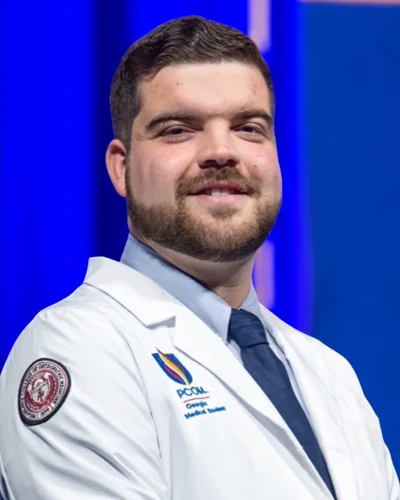
In pediatric emergency departments, blood draws are often used as part of routine medical evaluation in behavioral health assessments. But new research from Dylan Hurley, MPH, MAB, (DO ’28), a doctor of osteopathic medicine student at PCOM Georgia, suggests they rarely change patient care.
In a review of 209 cases involving children with autism spectrum disorder (ASD) presenting with behavioral health concerns, clinically significant findings—those that altered treatment—occurred in less than one percent of cases. The study, “Medically Unnecessary Venipuncture in Autism Spectrum Disorder Behavior Assessments,” examines whether routine laboratory testing meaningfully contributes to clinical decision-making. It was published in the February 2026 edition of Pediatric Emergency Care.
From Observation to Publication
As an emergency department technician at a hospital in Atlanta, Hurley saw children—many of them returning patients—move through the same protocol: behavioral health intake, medical screening, blood draw.
“This study came out of what I was witnessing in the pediatric ER on a day-to-day basis,” Hurley said. “It raised the question that should push us all in medicine: why do we do what we do?”
In many emergency departments, children presenting with behavioral or psychiatric concerns undergo laboratory testing as part of a medical clearance process before psychiatric admission with the intent of ruling out underlying medical causes. But Hurley’s study suggests those tests often offer little clinical value while introducing additional burdens—particularly for children with ASD.
For neurodivergent children, the emergency department can be an overwhelming environment. Bright lights and noise can heighten distress; procedures like blood draws can compound that experience. His findings point not only to limited clinical benefit, but also to broader implications—delays in care, increased costs, and the potential for retraumatization.
“We were taking this kid through the same process every time,” Hurley said, recalling a patient who had visited the ER multiple times in a month. “I couldn’t help but think about the stress we were creating.”
Ethics and Evidence
Hurley’s approach is shaped in part by his background in bioethics. Before medical school, he earned master’s degrees in public health and bioethics from Emory University—training that informed how he interpreted what he was seeing in the emergency department. He pointed to two principles that are particularly relevant: autonomy—the right to self-determination or free will—and nonmaleficence, the obligation to do no harm.
“When we restrain someone—physically or chemically—we are taking away that aspect of autonomy,” he said. “And if we’re doing something that isn’t medically necessary and could be causing harm, then we have to reconsider that.”
In the emergency department, those decisions often happen quickly, particularly for patients who may already be overstimulated or unable to communicate their needs. Despite national recommendations—including guidance from the American Academy of Pediatrics to avoid routine laboratory testing unless clinically indicated—the practice persists.
In some hospital systems, routine screening labs have been phased out. In others, they remain embedded in protocols, tied to institutional policies, insurance requirements, or admission criteria at inpatient psychiatric facilities. The result is a fragmented system where care can vary significantly by location.
Translating Research Into Care
Hurley centered his study on children with ASD because of the unique challenges they face in emergency care settings. Some patients may be nonverbal, while others may express distress in ways that are misunderstood. Many experience extended waits in the emergency department while awaiting placement in inpatient facilities equipped to meet their needs—highlighting both the human impact of system-level gaps and the need for targeted research.
For Hurley, the publication reflects the potential for translational research to influence clinical practice.
“This is where the rubber meets the road,” he said. “This is how we make change at the bedside.”
As an osteopathic medical student, Hurley sees the work as aligned with a whole-person approach to care—one that considers not only clinical data, but the broader context of a patient’s experience. That perspective is also personal. After being diagnosed with epilepsy in college, he said he experienced firsthand what it feels like to not be fully heard within the healthcare system.
“I think this project is, in some ways, about giving a voice to patients who may not be able to advocate for themselves,” he said. “Health is more than one dimension. It’s more than a blood draw.”
Hurley hopes to pursue a career in pediatric emergency medicine at the intersection of clinical care, ethics and research. He also hopes his work encourages others to question established practices.
“If you see something and you’re asking, ‘Why do we do this?’ That’s where it starts,” he said.
You May Also Like:
About PCOM Georgia
PCOM Georgia has been serving students and the community for 20 years as a branch campus of Philadelphia College of Osteopathic Medicine (PCOM), a private, not-for-profit, accredited institution of higher education established in 1899. Located in Suwanee (Gwinnett County), PCOM Georgia offers doctoral degrees in osteopathic medicine, pharmacy and physical therapy. Graduate degrees are offered in biomedical sciences, medical laboratory science and physician assistant studies. The campus joins PCOM South Georgia in Moultrie in helping to meet the healthcare needs of the state. Emphasizing "a whole person" approach to care, PCOM Georgia focuses on educational excellence, interprofessional education and service to the community. For more information, visit pcom.edu or call 678-225-7500. The campus is also home to the Georgia Osteopathic Care Center, an osteopathic manipulative medicine clinic, which is open to the public by appointment. For more information, visit pcomgeorgiahealth.org.
Contact Us
For general media inquiries, please contact the Office of Marketing and Communications at 215-871-6300 or communications@pcom.edu. Visit our media relations page to view contact information for public relations personnel.
Connect with PCOM Georgia
Media Inquiries
Kristen Hopf
Communications Content Specialist
Office of Marketing and Communications
Email: kristenho1@pcom.edu
Office: 215-871-6303