
Stay up to date with the latest stories and news from PCOM on Google.
Add us on GoogleShaping Surgeons: Training the Next Generation
Field Notes
March 1, 2026
By Kristen Hopf
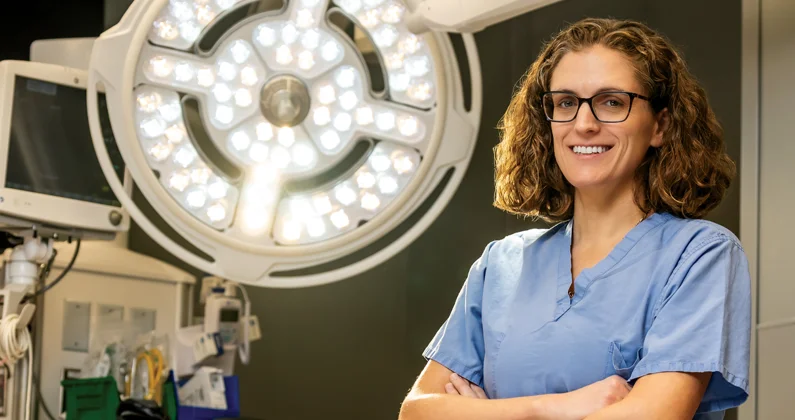
PCOM’s General Surgery Residency blends rigorous clinical preparation with an osteopathic, whole-person philosophy—forming surgeons who lead with skill, empathy and resilience.
Lindsey Perea, DO ’13, RES ’18, FACS, program director for the PCOM General Surgery Residency program, is a trauma and acute care surgeon at Penn Medicine Lancaster General Health and the medical director of trauma and acute care surgery research in Lancaster. A graduate of both PCOM’s DO program and its General Surgery Residency, she is board certified in general surgery and surgical critical care.
Dr. Perea’s exposure to the medical world and path toward surgery began in high school—first as an EMT and driver in an ambulance, then working as a tech in an emergency room for 10 years. At 17, a mentor predicted she would become a trauma surgeon.
“At the time, I said there was no way—that it was too high-paced of a field,” she said.
During medical school, however, she explored multiple specialties before committing to general surgery. Her surgical foundation began at PCOM, where residents she worked with as a student became early mentors. After residency and a fellowship in surgical critical care at Cooper University Health Care, she joined Lancaster General Health—just as PCOM residents began rotating there.
“Stepping into the program director role meant ensuring patient safety while supporting residents as they grow,” Dr. Perea said. “I aim to lead with an open-door, transparent approach and value feedback in both directions. My focus is continual improvement and making sure the program continues to evolve.”
Residents in the program complete over 200 major surgeries annually while learning from faculty across several affiliated hospitals, benefiting from dedicated academic time that includes daily teaching rounds and departmental meetings at each institution. Simulation and hands-on experience are central to the curriculum, and Dr. Perea and her team have expanded vascular trainings and breast biopsy labs, added multifaceted simulation days and developed a robust robotics simulation and training program combining didactic and practical components. Research also remains a core element of the program with residents presenting nationally at conferences every year. There are also daily opportunities to teach students and interns.
“I aim to lead with an open-door, transparent approach and value feedback in both
directions—
my focus is continual improvement and making sure the program continues to evolve.”
Lindsey Perea, DO ’13, RES ’18, FACS
“Residents are all required to do scholarly activity of some type during every year. I encourage them to get involved with research because, as surgeons, providing evidence-based care is critical,” Dr. Perea said.
Surgery and surgical education are inherently interdisciplinary, requiring close collaboration across specialties and within teams in the operating room, which naturally reinforces a holistic, whole-person approach to care.
Dr. Perea notes that surgical residents often naturally embody adaptability, humility and empathy—qualities that deepen through real-life experiences, from high-stakes surgeries to everyday patient care. Those moments, she says, reinforce an essential truth: every patient is someone’s loved one, and bringing one’s genuine, human self to the work is fundamental to good surgical care.