
Stay up to date with the latest stories and news from PCOM on Google.
Add us on GoogleWhere Trust Meets Teaching:
PCOM Physicians Guide a Family Through Life’s Tough Moments
December 8, 2025
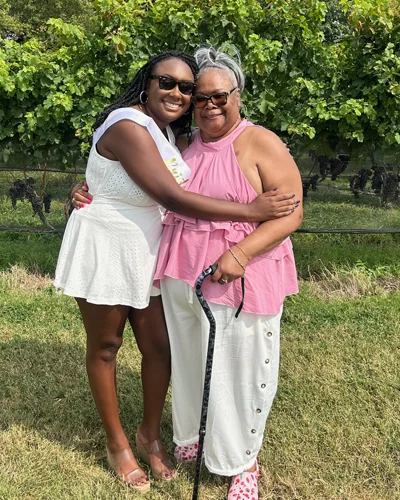
Donna Major has a simple guiding principle when seeking medical advice: When in doubt, call Dr. Veit.
That habit has carried the 68-year-old through a breast cancer diagnosis, calmed her nerves before surgery and helped her navigate bacterial meningitis. It also led to an osteopathic manipulative medicine referral that relieved pain from fluid in her knee. And it’s the reason her daughter, Kenya, now 30, has received care at Philadelphia College of Osteopathic Medicine’s Hassman Family Medicine Center since she became an adult.
“Whenever I have a concern or any doubt, I seek him first,” Major said of Kenneth J. Veit, DO ’76, PCOM’s provost and senior vice president for Academic Affairs, who has been her primary care physician for 20 years. “He listens, he calls me back, he makes me come in for an appointment. We talk about alternative care options and next steps. He’s kept me thriving for a very, very long time.”
What Major describes as “warm, caring, good old-fashioned doctor-patient care” is exactly the long-term trust and continuity Veit aims to build with his patients. Primary care physicians, he says, do more than diagnose and treat. They help coordinate care with specialists and explain complex recommendations.
“You’re an advocate for patients. You’re a navigator through a complex system,” Veit said. “One of my primary jobs is to ensure the right hand knows what the left hand is doing.”
Another core part of his work is teaching third- and fourth-year PCOM Doctor of Osteopathic Medicine students how to care for patients in the outpatient setting. During their rotations at PCOM’s Healthcare Centers, students are the first to meet with patients: gathering information, performing the initial exam, and presenting their findings when Veit enters the room.
Veit even asks patients to “grade” the students. Did they ask the right questions? Did they demonstrate empathy? Did they explain things clearly?
“That way patients are participating directly in the education of these young students,” Veit said. “That’s where the magic happens. And we have a patient population that, for the most part, buys into it.”
Major certainly does.
“Where else would the students learn all of these good patient-relationship qualities if they didn’t have a chance to go in, learn, be observed, and see how they did in their initial exam?” she said. “I like to see that; that’s very important.”
Her daughter, Kenya, is treated by George N. Spyropoulos, DO ’92, an assistant professor of Family Medicine. A few years ago, Spyropoulos guided her through a vaccine reaction that resulted in significant shoulder and arm pain and required an emergency room visit. On another occasion, he helped her obtain a medication refill during a lapse in insurance.
“He’s just been such a great doctor over my adulthood,” she said. “I transitioned from pediatrics to PCOM. PCOM has always been a safe space for me.”
Recently married, Kenya is a social worker in a local emergency department who has a pit bull-terrier mix named Sapphire. Donna is active in the Alpha Kappa Alpha sorority and maintains close relationships with her sorority sisters. Her “fur babies” are Charlie the chihuahua and Lucky, a papillon-toy fox terrier mix.
In healthcare and in life, trust is central for both women.
“When a patient is comfortable, they’ll tell you anything, and you’ll know how to diagnose what is best for the patient,” Donna Major said. “When you find a doctor who connects the dots much quicker because the patient can share a little more information, it gives them a better way to give you the best diagnosis and treatment. I choose doctors based on their training. If they had their training at PCOM, that’s a sure winner for me because I’ve had such beautiful outcomes.”
You May Also Like:
About Philadelphia College of Osteopathic Medicine
Established in 1899, Philadelphia College of Osteopathic Medicine (PCOM) has trained thousands of highly competent, caring physicians, health practitioners and behavioral scientists who practice a “whole person” approach to care—treating people, not just symptoms. PCOM, a private, not-for-profit accredited institution of higher education, operates three campuses (PCOM, PCOM Georgia and PCOM South Georgia) and offers doctoral degrees in clinical psychology, educational psychology, osteopathic medicine, pharmacy, physical therapy, and school psychology. The college also offers graduate degrees in applied behavior analysis, applied positive psychology, biomedical sciences, forensic medicine, medical laboratory science, mental health counseling, physician assistant studies, and school psychology. PCOM students learn the importance of health promotion, research, education and service to the community. Through its community-based Healthcare Centers, PCOM provides care to medically underserved populations. For more information, visit pcom.edu or call 215-871-6100.
Contact Us
For general media inquiries, please contact the Office of Marketing and Communications at 215-871-6300 or communications@pcom.edu. Visit our media relations page to view contact information for public relations personnel.
Connect with PCOM
Media Inquiries
Brandon Lausch
Executive Director, Strategic Communications
Office of Marketing and Communications
Email: brandonla@pcom.edu
Office: 215-871-6312