
Stay up to date with the latest stories and news from PCOM on Google.
Add us on GoogleWhen Rare Hits Home:
One Dean's Personal Connection to Rare Disease Day
February 27, 2026
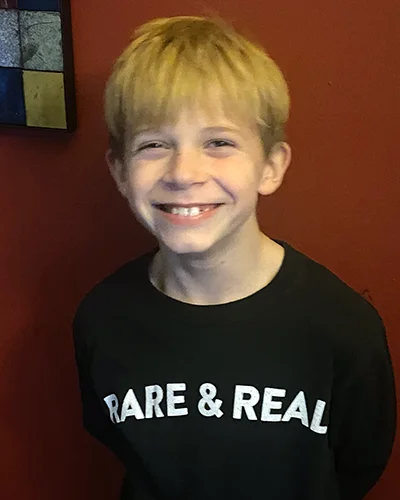
As Rare Disease Day approaches on February 28, Missy Terlecki, PhD, dean of the School of Professional and Applied Psychology at PCOM, shares her family's journey navigating a rare disease diagnosis.
With more than two decades of experience in higher education shaping future psychologists, Missy Terlecki, PhD, had long studied the mind, but it wasn't until her own family faced a sudden health crisis that she was truly able to see the demands of medicine in a deeply personal way.
In June 2020, Terlecki's 3-year-old son, Mitch, was playing at home when he suddenly lost movement in his limbs and began crying in severe back pain. Unable to soothe him, Terlecki and her husband, Matt, knew something was wrong and immediately took him to the emergency room.
By the time they arrived, Mitch had lost nearly all ability to walk with minimal ability to use his hands. He was transferred to Children's Hospital of Philadelphia (CHOP) for further evaluation.
Mitch was eventually diagnosed with acute flaccid myelitis (AFM), a rare neurological condition that causes sudden muscle weakness and paralysis. His diagnosis was followed by months of occupational and physical therapy, plasma and steroid transfusions, and extensive monitoring and testing—all compounded by the challenges of the COVID-19 pandemic.
“It was a difficult time where my husband and I were navigating working full-time while juggling childcare for our daughter, Mackenzie, who was 6 at the time, on top of making sure one of us was always with Mitch at the hospital,” she said. The pandemic made for extra stressors as Terlecki recalls the periodic temperature checks and the constant fear of spreading germs in such close quarters.
Mitch was one of a handful of children diagnosed with AFM in Pennsylvania that year, making it difficult to find resources and information. “We had to become our own experts, because no one else really knew what it was,” Terlecki said.
Eventually, she found support and camaraderie among other parents through online AFM communities. Facebook groups became a space where families shared empathy, advice and reassurance amid uncertainty.
AFM remains somewhat of a medical mystery that is often misdiagnosed. Early research points to possible links with viral infections or insect bites. Most children affected regain partial mobility, with only about 10% achieving a full recovery, like Mitch.
Now 9 years old, Mitch is running across soccer fields with the same determination he showed during his recovery. Watching him laugh and play is something Terlecki and her family never take for granted, as they remain mindful of how differently his story could have turned out.
“We understand Mitch's prognosis could have had a very different outcome, which makes us grateful for every ‘normal’ day we get,” Terlecki said.
You May Also Like:
About Philadelphia College of Osteopathic Medicine
Established in 1899, Philadelphia College of Osteopathic Medicine (PCOM) has trained thousands of highly competent, caring physicians, health practitioners and behavioral scientists who practice a “whole person” approach to care—treating people, not just symptoms. PCOM, a private, not-for-profit accredited institution of higher education, operates three campuses (PCOM, PCOM Georgia and PCOM South Georgia) and offers doctoral degrees in clinical psychology, educational psychology, osteopathic medicine, pharmacy, physical therapy, and school psychology. The college also offers graduate degrees in applied behavior analysis, applied positive psychology, biomedical sciences, forensic medicine, medical laboratory science, mental health counseling, physician assistant studies, and school psychology. PCOM students learn the importance of health promotion, research, education and service to the community. Through its community-based Healthcare Centers, PCOM provides care to medically underserved populations. For more information, visit pcom.edu or call 215-871-6100.
Contact Us
For general media inquiries, please contact the Office of Marketing and Communications at 215-871-6300 or communications@pcom.edu. Visit our media relations page to view contact information for public relations personnel.
Connect with PCOM
Media Inquiries
Gabrielle DePietro
Associate Director, News and Media Relations
Office of Marketing and Communications
Email: gabrielde2@pcom.edu
Office: 215-871-6304