
Stay up to date with the latest stories and news from PCOM on Google.
Add us on GooglePCOM Researchers Join National Dialogue on Alzheimer’s at ASM Conference
June 25, 2026
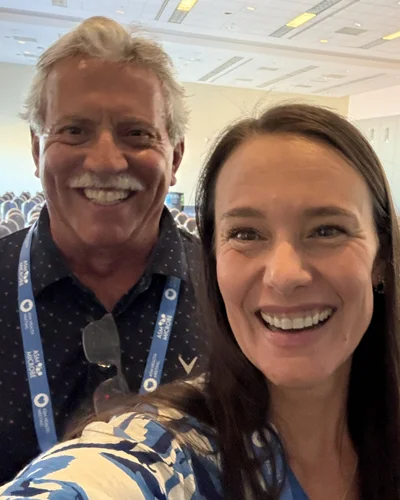
Nikki Schultek, BS, and Brian Balin, PhD, of the Pathobiome Research Center (PBRC) and Center for Chronic Disorders of Aging at PCOM, joined colleagues from the Alzheimer’s Pathobiome Initiative (AlzPI) to present their Alzheimer’s-infection research at the American Society for Microbiology (ASM) Annual Meeting in Washington, D.C., earlier this month.
The annual meeting, which brought together researchers across the country, included various presentations examining the growing body of evidence linking infectious processes to neurodegenerative disease, an area of increased focus in Alzheimer’s research.
The informational sessions began with Garth Ehrlich, PhD, of Drexel University College of Medicine, a pioneer in molecular diagnostics and pathobiome research and member of the AlzPI consortium. During his presentation, Ehrlich underscored the importance of interdisciplinary thinking in advancing understanding of complex chronic conditions.
Following suit was Schultek who gave an overview of the history of dementia and infection, providing a 360-degree overview of the past, present, and future, including what inspired her to co-create the AlzPI consortium and begin her research with PCOM.
“Discussions that used to sit on the margins are now entering mainstream scientific conversations, and that has given me optimism and hope for where chronic illness research is headed,” she said.
Dr. Balin then took the stage to provide a detailed timeline of his decades-long research into the role of Chlamydia pneumoniae in Alzheimer’s disease. Balin, who has been a leading figure in advancing the infection hypothesis in the United States since 1998, was able to contextualize his findings within the broader landscape of Alzheimer’s research, challenging longstanding assumptions surrounding amyloid plaques and tau tangles as primary drivers of disease.
The session concluded with a presentation from Or Shemesh, PhD, of the University of Pittsburgh and Hebrew University of Jerusalem, who shared compelling data suggesting that hallmark Alzheimer’s pathologies may function as innate immune responses to infectious agents, including viruses and bacteria. Shemesh also highlighted emerging evidence of sex-based differences in immune response, pointing to important implications for both research and therapeutic development.
Reflecting on the event, Schultek said it was the audience’s reaction that stuck with her the most.
“What encouraged me most was the response from our attendees,” she said. “There were a lot of people that stayed well past the presentation to ask questions so it was great to see such genuine curiosity and engagement.”
You May Also Like:
About Philadelphia College of Osteopathic Medicine
Established in 1899, Philadelphia College of Osteopathic Medicine (PCOM) has trained thousands of highly competent, caring physicians, health practitioners and behavioral scientists who practice a “whole person” approach to care—treating people, not just symptoms. PCOM, a private, not-for-profit accredited institution of higher education, operates three campuses (PCOM, PCOM Georgia and PCOM South Georgia) and offers doctoral degrees in clinical psychology, educational psychology, osteopathic medicine, pharmacy, physical therapy, and school psychology. The college also offers graduate degrees in applied behavior analysis, applied positive psychology, biomedical sciences, forensic medicine, medical laboratory science, mental health counseling, physician assistant studies, and school psychology. PCOM students learn the importance of health promotion, research, education and service to the community. Through its community-based Healthcare Centers, PCOM provides care to medically underserved populations. For more information, visit pcom.edu or call 215-871-6100.
Contact Us
For general media inquiries, please contact the Office of Marketing and Communications at 215-871-6300 or communications@pcom.edu. Visit our media relations page to view contact information for public relations personnel.
Connect with PCOM
Media Inquiries
Gabrielle DePietro
Associate Director, News and Media Relations
Office of Marketing and Communications
Email: gabrielde2@pcom.edu
Office: 215-871-6304