
Stay up to date with the latest stories and news from PCOM on Google.
Add us on GoogleBeyond the Title: What Physician Assistants Do
August 31, 2026
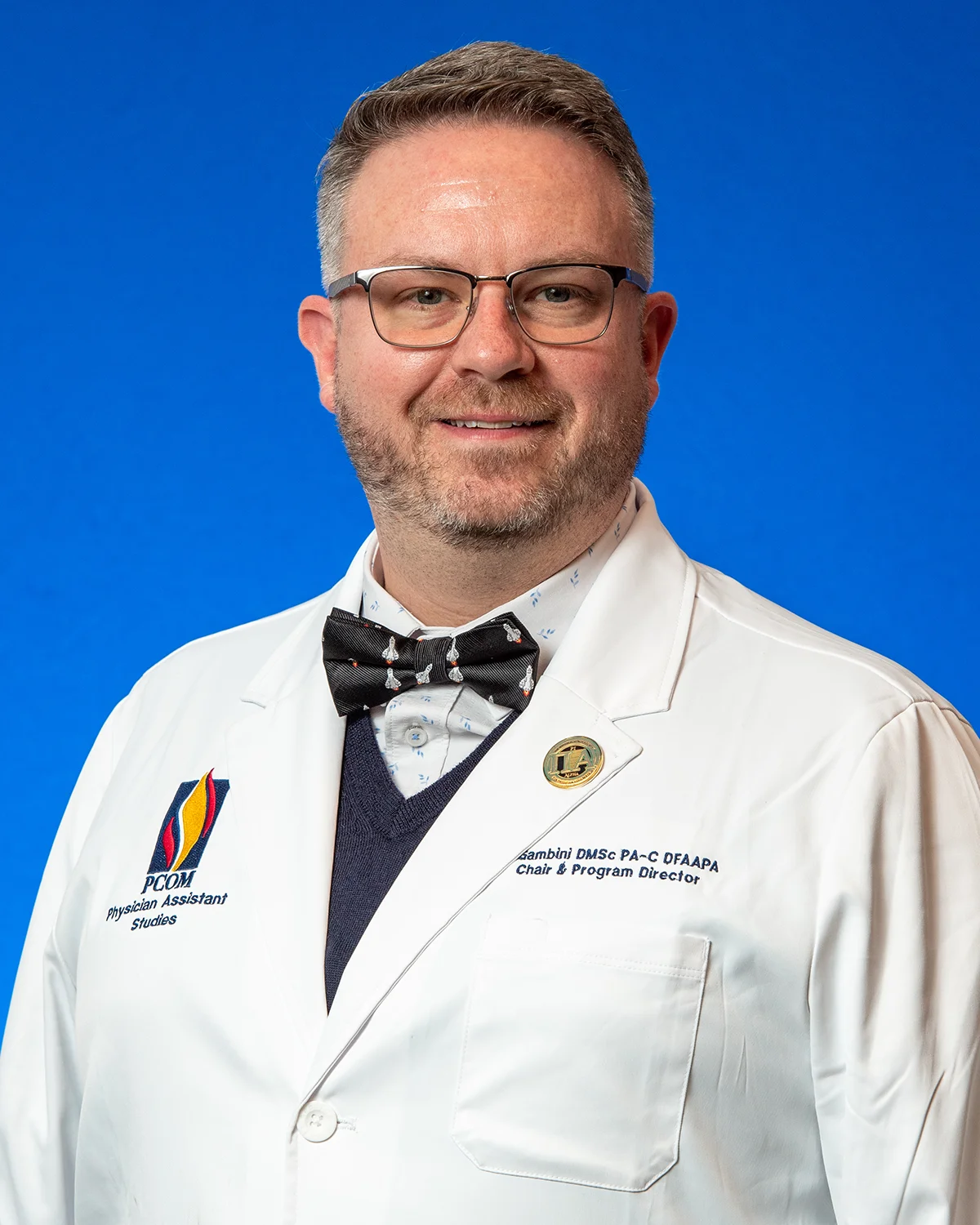
Physician Assistants (PAs) have long been an essential part of patient care, yet misconceptions about what they do and how they're trained remain common. To help clear up some of that confusion, Justin M. Gambini, DMSc, PA-C, DFAAPA, newly appointed Chair and Program Director of the MS in Health Sciences - Physician Assistant Studies program at PCOM, shares his perspective on the profession, its strengths and how it continues to evolve.
Dr. Gambini brings over 15 years in emergency and hospital medicine to his new role. He has chaired PA programs at several institutions, continues to serve as an accreditation reviewer for national accrediting organizations, and is a published author and national speaker.
The Educational-to-Practice Transition
One of the most widespread myths about the PA profession concerns the transition from educational training to clinical practice. Gambini says PAs are intentionally trained as generalists—and he sees that as an asset, not a shortcoming.
“PA education is deliberately built on a generalist medical model, and that's a key strength, but it does mean the specialty-specific ramp-up has to be intentional rather than assumed,” he said. “I've seen this from both sides: as a clinician who built a subspecialty skill set in point-of-care ultrasound on top of generalist emergency and hospital medicine training, and now as a program administrator responsible for how new graduates are prepared to make that same leap.”
Quantifying the “Value Add”
Another misconception involves how the value of PAs is measured. Census and productivity data tend to focus on volume, but Dr. Gambini says those metrics fail to capture the decision-making abilities of PAs.
“Independent workups, treatment plans, discharge decisions and continuity of care are better indicators,” he explained. “These elements demonstrate that PAs often serve as primary care providers and decision-makers, not merely support staff.”
Correcting Public Narratives
Public and internal narratives also lag behind reality. Gambini says closing that gap requires visible representation and consistent messaging about the PA profession.
“A PA's generalist training and lateral mobility across specialties make them uniquely suited to fill gaps and serve communities in need.”
Justin M. Gambini, DMSc, PA-C, DFAAPAProfessor, Chair and Program Director, Physician Assistant Studies
“Having PAs present cases, participate in quality committees, and be credited for their decisions helps shift perceptions,” he said. “Using clear, plain language at the first patient encounter further clarifies their autonomous role and can help reduce patient uncertainty.”
As healthcare systems face growing provider shortages and physician burnout, PAs are increasingly stepping into roles as long-term, longitudinal care providers. A 2024 study in BMC Health Services Research found that over half of PAs change specialties during their careers, and many work in medically underserved areas—underscoring their flexibility and importance.
“A PA's generalist training and lateral mobility across specialties make them uniquely suited to fill gaps and serve communities in need,” Gambini said. “A physician assistant can go where the need is—a rural hospital, an underserved primary care clinic, a specialty short on hands—without re-entering years of additional formal training. If we want to close access gaps, we should focus on utilizing that flexibility, rather than narrowing it.”
On a personal note, Dr. Gambini shared why the PA profession resonates with him deeply.
“I'm a first-generation college student, born and raised in Appalachia, West Virginia, where health care was not something I could take for granted growing up. That's a big part of why, when I was accepted into several MD and DO programs, I chose the PA path instead—between where I came from, what I'd seen about access to care, and the lateral mobility the profession offered, it was the clearer route into medicine for someone like me.
That lateral mobility isn't just a nice career feature—I think it's one of the most underappreciated tools we as PAs have for addressing healthcare inequity and healthcare deserts.”
You May Also Like:
About PCOM Georgia
PCOM Georgia has been serving students and the community for 20 years as a branch campus of Philadelphia College of Osteopathic Medicine (PCOM), a private, not-for-profit, accredited institution of higher education established in 1899. Located in Suwanee (Gwinnett County), PCOM Georgia offers doctoral degrees in osteopathic medicine, pharmacy and physical therapy. Graduate degrees are offered in biomedical sciences, medical laboratory science and physician assistant studies. The campus joins PCOM South Georgia in Moultrie in helping to meet the healthcare needs of the state. Emphasizing "a whole person" approach to care, PCOM Georgia focuses on educational excellence, interprofessional education and service to the community. For more information, visit pcom.edu or call 678-225-7500. The campus is also home to the Georgia Osteopathic Care Center, an osteopathic manipulative medicine clinic, which is open to the public by appointment. For more information, visit pcomgeorgiahealth.org.
Contact Us
For general media inquiries, please contact the Office of Marketing and Communications at 215-871-6300 or communications@pcom.edu. Visit our media relations page to view contact information for public relations personnel.
Connect with PCOM Georgia
Media Inquiries
Joy Williford
Assistant Director, News and Media Relations
Office of Marketing and Communications
Email: joyde@pcom.edu
Office: 470-572-7558