
Stay up to date with the latest stories and news from PCOM on Google.
Add us on GoogleBridging Skill and Collaboration
March 1, 2026
By Anna Bokarev
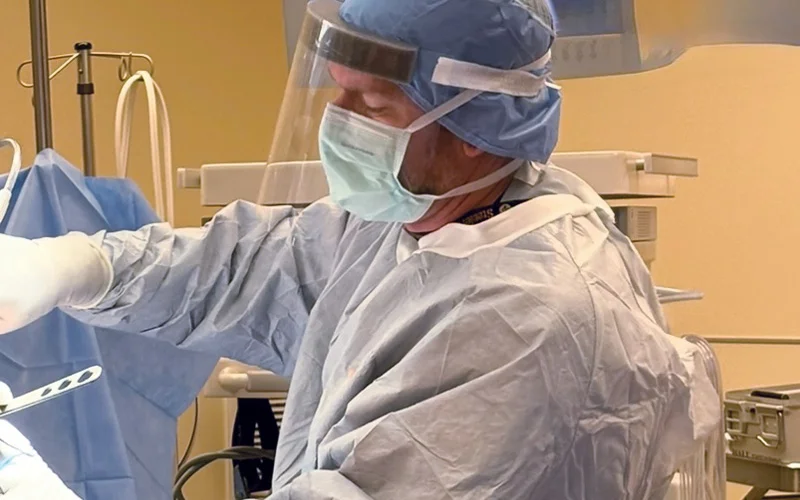
PCOM-trained physician assistants elevate perioperative practice through clinical acumen, interdisciplinary coordination and patient-centered care.
Physician assistants play an increasingly sophisticated role in surgical settings, integrating technical skill, diagnostic reasoning and patient advocacy across every phase of care. Their contributions extend beyond procedural support; they anchor perioperative continuity, optimize clinical workflow and reinforce the patient-centered ethos central to contemporary surgical practice.
“Working side by side in the operating room, the surgeon and I develop a rhythmic cadence that can get the patient through the operation faster,” says Alison Ranade, MS/PA-C ’08, a physician assistant in the UC Davis Medical Center Cardiothoracic Surgery Department in Sacramento, California. She anticipates the surgeon’s needs, manages key operative steps and helps streamline the procedure. Her skills and versatility help reduce the time the patient is on the heart lung machine, improving patient outcomes.
Before a patient goes into surgery, Ms. Ranade spends time getting to know them, taking their medical, surgical and social histories. Her attention to detail outside the operating room is crucial to the work inside of it—intricate information can help her and the surgeon work together to navigate intraoperative decisions. “A patient’s anatomy, comorbidities or prior interventions can change how we approach cannulation sites or device placement,” she explains.
Working with patients perioperatively, physician assistants are uniquely positioned to bridge the different stages of the healthcare journey. Jason Kuchta, MS/PA ’04, an orthopedic surgical physician assistant and advanced practice provider (APP) supervisor at the University of Pittsburgh Medical Center Tri-Rivers Musculoskeletal Center, ensures this continuity in day-to-day practice. In addition to helping manage a robust adult reconstruction surgical service, he co-leads a team of 32 APPs.
Trained to be adaptable and to work across specialties, Mr. Kuchta coordinates diagnostic imaging; facilitates communication with orthopedic surgeons, anesthesiologists and nursing teams; and helps guide postoperative protocols that promote early mobility and safer recovery trajectories.
“The continuity we provide helps maintain momentum from clinic to OR to recovery,” he notes. “Patients benefit when every transition is intentional.”
The whole-person philosophy also helps bridge collaborative, technical skills with the personal connection surgical patients need.
“One of the beautiful things about health care is that in the end, you’re dealing with people,” says Jarrod Luttjohann, MS/PA-C ’12, a vascular surgery physician assistant in rural Georgia. For him, building confidence and trust is an integral part of working with surgical patients. He knows he’s met that goal when he enters a patient’s room and sees their expression shift from worry to relief.
“Developing meaningful relationships is not only a way to comfort patients. It is a way to ensure patients have control over their health care,” he affirms.
Whether that means breaking down medical jargon, anticipating the patient’s questions or preparing patients for life post-procedure, physician assistants integrate patients into their healthcare experience and fuel their agency in medical settings.
Doing so requires strong interpersonal skills. Haley Geosits, MS/PA-C ’23, has developed her approach based on her unique experience as a patient. Ms. Geosits works with otolaryngology patients at Thomas Jefferson University Hospital in Philadelphia, the same hospital in which she was diagnosed and treated for thyroid cancer prior to starting physician assistant school. Because of her personal perspective, Ms. Geosits understands firsthand the fear and vulnerability patients may feel. Now, when she connects them to resources like creative arts therapy or teaches them how to use medical devices like laryngectomy tubes at home, she draws on both her clinical training and her lived experience to deliver the best possible care.
Grounded in a training model that emphasizes collaboration, adaptability and the whole-person
approach, PCOM physician assistants are redefining what it means to support surgical
care. Their ability to move fluidly between technical execution, care coordination
and patient advocacy strengthens perioperative
systems and elevates the surgical experience.