
Stay up to date with the latest stories and news from PCOM on Google.
Add us on GoogleBetween Trauma Bays and Battlefields
March 1, 2026
By Jennifer Schaffer Leone
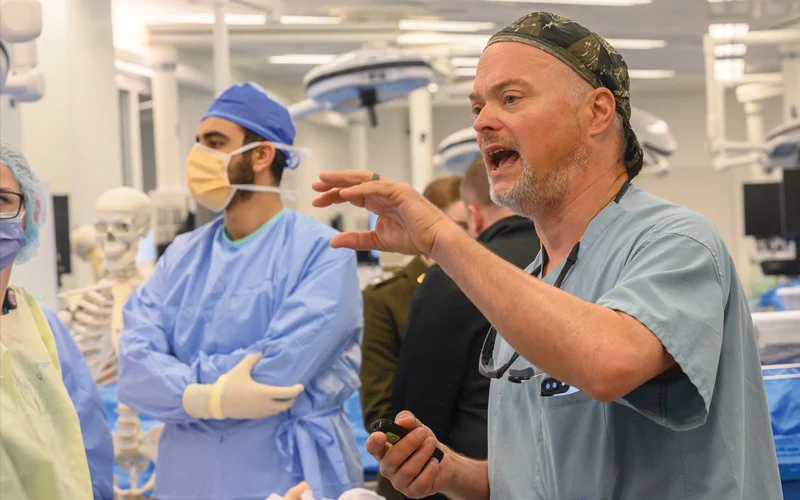
In the crucible of crisis, skill meets discipline, and the next generation of surgeons is forged.
John Chovanes, DO ’02, RES ’06, has stood over patients pulled from the burning towers of the World Trade Center, on dust-choked streets in Baghdad and Kabul, and inside remote combat outposts where the line between life and death can be measured in millimeters. In those moments, steadiness becomes a lifeline—a lifeline that he now passes on to the next generation of surgeons.
“Trauma surgery is a profound and honorable vocation. It is a calling,” he says. “When the moment comes, you act calmly, competently, respectfully and, at times, very intensely. You bring your best every single time.”
Early Lessons in Urgency
Before entering medical school, Dr. Chovanes was immersed in acute care. One of Pennsylvania’s youngest EMTs, he went on to serve as a paramedic, an emergency department nurse and later as one of the earliest flight paramedics with University MedEvac—the first medical evacuation helicopter in Pennsylvania and New Jersey.
“I learned early on that trauma is a great equalizer,” he says. “Anyone can become a patient in the blink of an eye. Your job is to be ready.”
At PCOM, he found his mentor in Arthur Sesso, DO ’81, chairman of surgery, who shaped both his clinical precision and his connection to military medicine.
“Dr. Sesso was a leader’s leader—a real ‘Rat Patrol’ guy,” Dr. Chovanes recalls with
a laugh. “He pushed us to prove ourselves each day, each case. He required that we
be meticulous, disciplined and fearless.”
He remembers how Dr. Sesso once made the surgical residents wear red bands on their
white coats so everyone in the hospital could identify them. “He wanted us visible—responsible—and
committed to the team.”
Building Elite Readiness at Cooper
When Dr. Chovanes arrived at Cooper University Health Care in 2010, he entered a uniquely demanding clinical ecosystem: New Jersey’s busiest Level I trauma center, serving a population of 2.7 million. “The mission here at Cooper is simple,” he says. “We prevent premature death and suffering. It’s collaborative, high-pressure, and one of the few places where you can learn this work exactly as it is—without dilution, without abstraction.”
Today, he serves as the founding medical director of Cooper’s Section of Military, Diplomatic, and Field Affairs (MILDAF), a program he established to prepare elite medical personnel for the unpredictability and extremity of combat and field operations. MILDAF embeds specialized teams directly into Cooper’s trauma bays for immersive, real-time clinical experience. Trainees include U.S. Army Special Forces medical sergeants, Special Operations surgical and critical care teams, FBI and federal tactical medics, Department of Homeland Security medical personnel, and U.S. Department of State medical providers assigned to high-threat diplomatic posts.
The program is not theoretical—and intentionally so.
“It is not simulation,” Dr. Chovanes emphasizes. “These are real people with real injuries. The patterns mirror what you would see downrange. But here, you are never alone. You have seasoned trauma surgeons standing beside you. They become your guardian angels.”
For operators preparing for austere, resource-limited or high-risk environments, the experience is transformative. It builds not only clinical mastery but the psychological composure that trauma care demands when seconds compress and the margin for error disappears.
Service on the Front Lines
Since 2001, Dr. Chovanes has completed six deployments with the U.S. Army Reserve Medical Corps, serving at the 325th Combat Support Hospital in Tikrit, Forward Operating Base Salerno in Khost, and Camp Manion during the Third Battle of Fallujah.
He received the Army Commendation Medal for meritorious service and the Soldier’s Medal for heroism after providing emergency surgical care to a Port Authority officer trapped in the rubble of the World Trade Center on September 11, 2001. In January 2024, he was honored with the John P. Pryor, MD Distinguished Service Award – The Eastern Association for the Surgery of Trauma. The award is named for the Army trauma surgeon killed in action in Iraq on Christmas Day 2008, recognizing his exceptional contributions to military medicine and trauma surgery.
“People imagine heroism,” he says. “But trauma surgery—civilian or military—is long hours, difficult cases, and no glamour. You do it because restoring someone, giving them back their life, matters.”
This commitment extends beyond the battlefield. Dr. Chovanes maintains a close partnership with the U.S. Army Medical Command and the Office of the Army Surgeon General, led by PCOM alumna Lt. Gen. Mary Krueger Izaguirre, DO ’95, through embedded military–civilian training programs. As part of the Army Medical Department Military–Civilian Trauma Team Training program, he hosts active-duty Army medical personnel—surgeons, nurses, and technologists—for multi-year assignments in Cooper’s high-volume trauma environment, giving them immersive, real-world experience before deployment.
“When you hit the ground overseas, you cannot be learning the basics,” Dr. Chovanes says. “Every trauma I see here, I ask myself: How would this play out in combat? That mindset keeps you sharp. Moreover, it reinforces the Army’s mission to maintain a highly-trained, deployable medical force.”
A Legacy Grounded in Faith and Service
Dr. Chovanes’s work is sustained as much by faith and family as it is by training.
“I have a wife and three children. My legacy to them is simple: Be true, serve well and bring your best every day. Faith is what carries you through the hard moments,” he says.
He also thinks of Dr. Sesso often—not only for his surgical instruction, but for the small lessons that stayed with him.
“Dr. Sesso told me to buy an old M37 4x4—the grandfather of all trucks—and rebuild it. It wasn’t about the truck,” he recalls. “It was about commitment, patience and attention to detail. If you respect the small tasks, you’ll respect the big ones.”
Teaching More Than Technique
Dr. Chovanes mentors medical students, residents and military trainees who come to Cooper to learn not only surgical technique, but the mental and emotional steadiness required in crisis.
“Plenty of people have the hands. Others have the brain. Still others can communicate,” he says. “But not everyone can hyper-concentrate when a life hangs by a thread. That focus—that calm in the storm—is what separates good from great.
“You show up calm, competent and compassionate every time,” he says. “That’s the mark of a life and a career that truly matters.”