
Stay up to date with the latest stories and news from PCOM on Google.
Add us on GoogleMedicine in the Media: The Power of Being Heard
August 25, 2026
By Jennifer Schaffer Leone
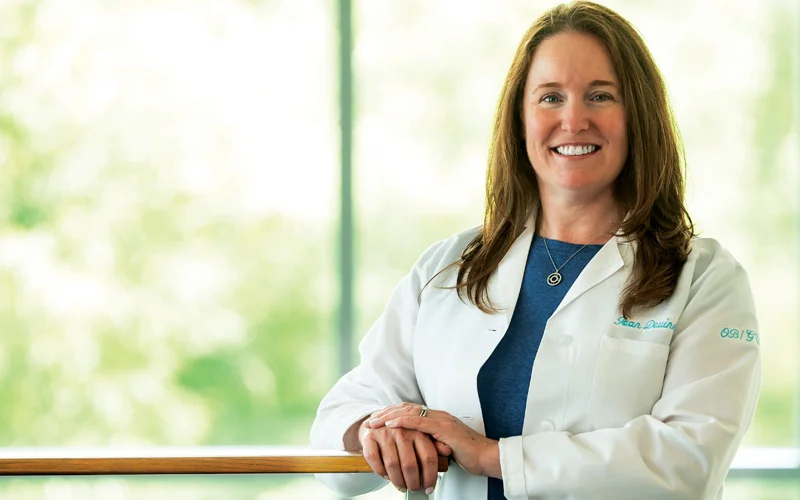
How Joan Keegan Devine, DO ’06, FACOG, became part of one patient’s public story of care, trust and loss.
In Philadelphia, Kylie Kelce is a familiar and trusted voice, known for her candor, humor and unfiltered take on family life. A former collegiate field hockey player, she now hosts the podcast “Not Gonna Lie,” which reaches more than 1.2 million listeners.
She is also married to Jason Kelce, the Super Bowl champion and longtime Philadelphia Eagles center, whose passionate 2018 championship parade speech on the steps of the Philadelphia Museum of Art—delivered in full Mummers regalia—is etched in city lore.
Together, the Kelces sit at the intersection of sports, media and Philadelphia culture.
In March, Ms. Kelce used her platform to share something deeply personal. On her podcast, she reflected on a missed miscarriage in one of her early pregnancies and the care she received from Joan Keegan Devine, DO ’06, FACOG, her physician, her “soul OB.”
She did not simply recall what Dr. Devine told her during one of the most difficult moments of her life. She recalled how it was said.
“You were gentle in the way that you delivered the news,” Ms. Kelce recalled, Dr. Devine seated next to her on the podcast. “You very rationally laid out the options and said, ‘You don’t have to decide right this minute.’ ”
There was clarity in the language and space in the moment—an understanding that clinical precision alone is not always enough. For Ms. Kelce, it transformed an experience defined by loss into one she could move forward from.
A Physician Who Teaches
For Dr. Devine, care and education are inseparable.
“I see my job as helping patients understand what is happening to them and why,” she says. “This allows them to make informed decisions and become empowered participants in their care.”
She sees medicine as something not only delivered, but also taught and translated in a world where patients are navigating an overwhelming flow of health information. While she emphasizes evidence-based medicine, she is equally intentional about not letting information replace human connection.
“I want to be approachable,” she says. “Not intimidating.”
That philosophy took shape during her training at Philadelphia College of Osteopathic Medicine and residency at Lankenau Medical Center. Today, Dr. Devine maintains a full-spectrum practice at McConnell & Associates OB/GYN, Axia Women’s Health, spanning preventive care, office procedures and minimally invasive gynecologic surgery.
She also views teaching as central to her role, particularly in mentoring young physicians entering obstetrics and gynecology, a field she describes as both deeply meaningful and increasingly strained.
A Relationship Built on Trust
Women’s health care is defined by continuity—across decades, spanning generations. Dr. Devine first met Ms. Kelce long before she became a public figure. Her mother, too, was a patient in the practice.
That continuity builds familiarity—and with it, trust.
Dr. Devine follows patients through pregnancy, childbirth and menopause as well as preventive care and unexpected conditions. For many healthy patients between 20 and 40, she is their only physician.
“I look at the whole patient—prevention, risk factors and support systems,” she explains. “In many cases, I fill gaps in care when patients do not have a primary care provider. I encourage them to build broader support through preventive follow-up and specialist care.”
That work has grown more complex. Burnout, staffing shortages, and legal uncertainty have intensified pressures in obstetrics and gynecology, particularly following the U.S. Supreme Court’s 2022 decision in Dobbs v. Jackson Women’s Health Organization, which eliminated the federal constitutional right to abortion and shifted regulatory authority to individual states.
“Women’s health is hard,” Dr. Devine says. “My field is always under scrutiny.”
She notes that these pressures existed long before Dobbs, but have since added new layers of clinical and emotional strain to daily practice.
A Shared Philadelphia Thread
In Philadelphia, sports are a shared language. For Dr. Devine, Eagles fandom began in childhood in the Lehigh Valley, shaped by a father who was an avid fan and Sundays spent watching games together. Today, that tradition continues through her husband, Mike, and two sons, Michael and William.
The familiarity often carries into the exam room, where a passing reference—or a well-timed win—can ease anxiety and create an immediate sense of connection.
During the Eagles’ run to Super Bowl LVII, the Philadelphia thread became especially personal. While watching a playoff game with her husband, Dr. Devine knew she would soon be caring for Ms. Kelce, who was nearing the end of her third trimester with her third child.
As a precaution, Dr. Devine and her colleague, Colleen Dempsey, MD, traveled with the Kelce family to Arizona and coordinated care with a local hospital. The world watched the “Kelce Bowl,” a nickname for the 2023 Super Bowl featuring brothers Jason Kelce of the Philadelphia Eagles and Travis Kelce of the Kansas City Chiefs. But behind the scenes, there was the planning and partnership that underpinned maternal medicine.
When Medicine Becomes Conversation
Ms. Kelce’s openness on her podcast resonated with many listeners because it gave
voice to an experience often kept private. Miscarriage affects roughly one in four
pregnancies, yet it is still rarely discussed openly.
“I truly don’t think that I would have had the courage to try again so quickly had
you not handled that with such care,” Ms. Kelce said on her show.
For Dr. Devine, that kind of visibility matters.
“It helps normalize what people are going through,” she says. “And it helps them feel less alone. There is no single way to experience loss. Acknowledging it—even when uncomfortable—helps people heal.”
What Endures
On a typical day in the office, Dr. Devine may see up to 27 patients. The pace is steady; still, she is deliberate about slowing down when it matters most.
“I remind myself: Check your own pulse,” she says. “This patient is hearing big news.
“My patients may not remember every detail of a conversation, but they remember that they were heard. I give them space. I encourage questions. I let them process, and I make sure they know they can reach back out.”
For Ms. Kelce, that trust became part of a longer continuum of care, with Dr. Devine guiding her through four pregnancies and deliveries.
“That experience made it even more clear that I was in the right hands,” Ms. Kelce said on the podcast. “I hope everyone finds their soul OB the way I have.”